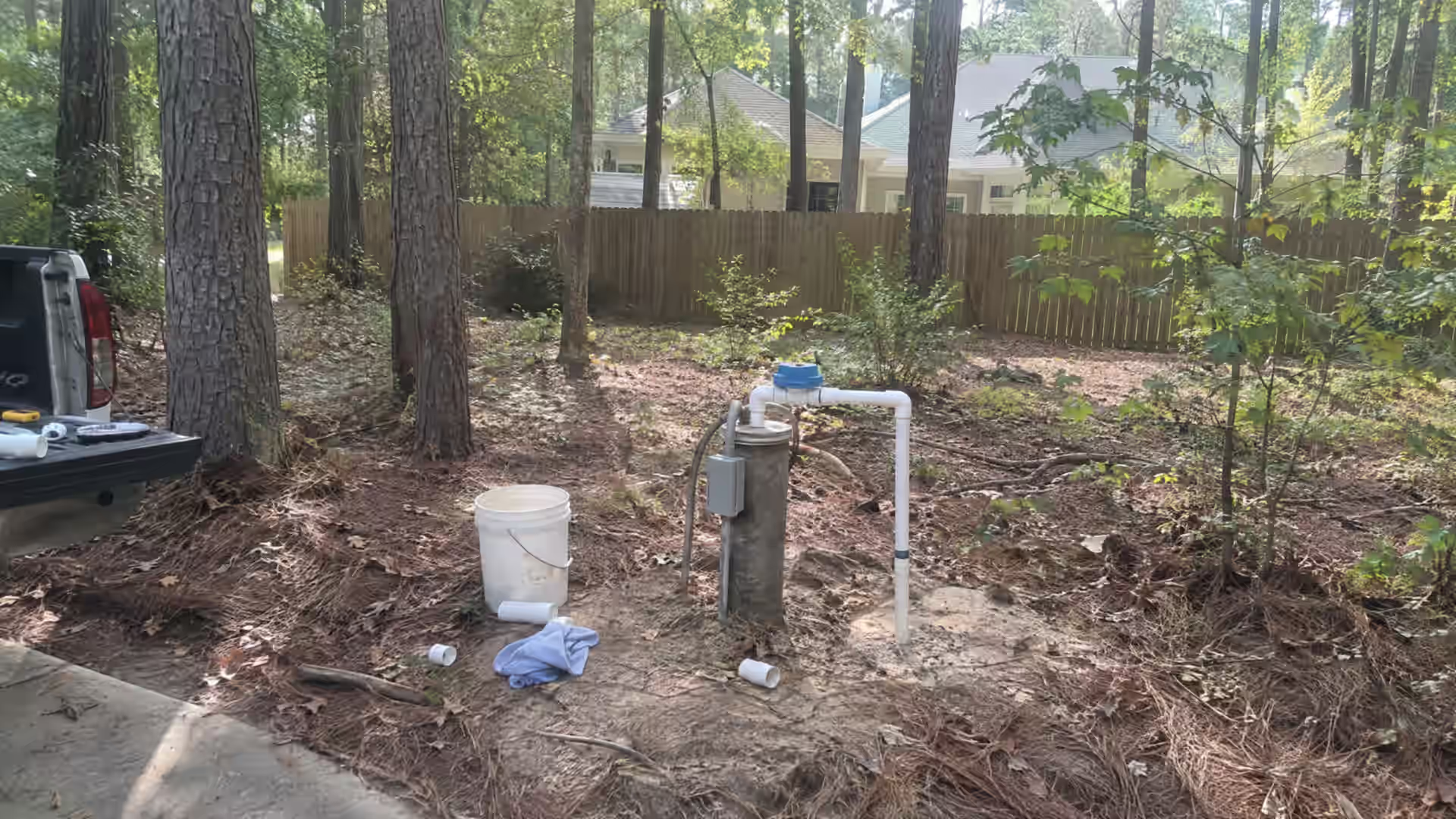
Hope Mills grew outward from a lumber camp and grist mill established in 1766, and the town's water supply grew unevenly with it. Parts of Hope Mills are metered and parts run on private wells, sometimes on the same road, so which side of that line your property sits on decides whether a pressure problem belongs to the utility or to you. Fayetteville Well Pump Repair works the well side of it across southern Cumberland County, from the lake and the historic district out to the county line.
We handle the full range of private well work in Hope Mills: pump repair and replacement, pressure tank and switch work, water testing, treatment and filtration, casing repair and new drilling. We work with homeowners, landlords and property managers, and on a town split between two supplies we spend a fair part of any first visit simply establishing what your house is actually connected to. A well on a metered street still behaves like a well, and the symptoms read nothing like a utility fault.
Your well draws from the Black Creek aquifer, which runs under the whole county as Coastal Plain sand rather than the fractured rock the Piedmont sits on. Wells here finish at 100 to 250 ft instead of the 150 to 500 ft a rock well needs, which is why drilling costs less on this side of the fall line and why shallow and jet pumps still work where rock would force a submersible. Sand is also what wears your foot valve, because suspended grit scores the seat, so a jet system losing prime in Hope Mills usually has a mechanical cause rather than an installation fault.
Properties near the municipal boundary tend to carry older wells, because a well drilled before the line arrived often stays in service for irrigation, livestock or a workshop long after the house switches over. Those secondary wells go untested for years, and sandy soil lets surface water reach the aquifer quickly, which means water testing matters more on them than on your primary supply. A well nobody drinks from is still a well nobody has checked, and it still draws from the same aquifer as Rockfish and Grays Creek.
Hope Mills at a glance
- County
- Cumberland County
- Aquifer
- Black Creek, confined
- Typical well depth
- 100 to 250 ft
- Well permits
- Cumberland County Department of Public Health
What a job costs in Hope Mills
A typical Hope Mills job: 160 ft well, submersible pump at 11 years, intermittent pressure loss traced to a waterlogged bladder tank rather than the pump. Tank replaced, pressure switch reset to 40/60, total $1,300 against the $1,500 to $2,500 the homeowner had budgeted for a replacement pump.
| What the job is | Typical range | Unit |
|---|---|---|
| External component: pressure switch, control box, wiring, primingThe pump itself is fine. Cheapest outcome and the most common one. | $150 – $500 | installed |
| Pressure tank replacementTank, tank tee, gauge, switch and fittings, sized on drawdown. A waterlogged tank is what makes a pump short-cycle. | $1,000 – $2,300 | installed |
| Shallow well or jet pump, to about 25 ftCommon on Coastal Plain sand wells, where the water table sits high enough that a jet pump still works. | $600 – $1,400 | installed |
| Deep submersible pump, well 100 to 200 ftTypical Fayetteville well depth. Price covers pulling the old pump, drop pipe and wire. | $1,500 – $2,500 | installed |
| Deep submersible pump, well 300 to 400 ft or higher horsepowerDepth drives horsepower and hoist labor together. Every extra 100 ft adds roughly $500 to $1,000 in pipe, wire and time. | $2,800 – $5,500 | installed |
| Full system replacement: pump, tank, wiringWorth doing together when the pump is original and the tank is the same age. | $3,500 – $6,000 | installed |
What moves the number
- Every additional 100 ft of well depth+$500 to $1,000
- Emergency, weekend or after-hours call+25% to 50%
No water this morning?
Tell us what the pump is doing and we will tell you what it costs to put right.
Well questions from Hope Mills
Do you service wells in Hope Mills?
Yes. Hope Mills sits inside our regular Cumberland County service area, and we run pump repair, water testing and drilling work throughout the area on both primary and secondary wells.
How do I know if my Hope Mills property is on a well or municipal water?
A pump you can hear cycling, a pressure tank in the crawlspace or garage, and no water meter at the curb all point to a private well. If you are on a well the pressure behavior is yours to manage, since nothing upstream regulates it.
How deep are wells around Hope Mills?
Wells across Cumberland County typically run 100 to 250 ft into Coastal Plain sand aquifer, which is shallower than the 150 to 500 ft common in Piedmont fractured rock. That is why drilling here costs $6,500 to $11,500 rather than $9,200 to $16,500.
Should I test an irrigation well I do not drink from?
Yes, annually for bacteria. Sandy soil and a shallow water table let surface water reach the aquifer quickly, and a secondary well that nobody monitors is the one most likely to have a damaged cap letting contamination straight in.