Low water pressure from your well is usually a settings and storage problem, not a failing pump. That is why swapping the pump so often changes nothing at your shower head. At Fayetteville Well Pump Repair, we check your switch setting and your tank air charge first. Both fixes sit at the bottom of our published cost ranges, well under the $1,500 to $2,500 a new pump costs.
Two parts decide your water pressure. A third one stores it. Your pressure switch decides when the pump starts and stops. Your tank holds water between those two points. Your pump only refills what the tank has already given away. So a perfectly healthy pump still gives you a weak shower when either of the other two has drifted.
The normal setting here is 40/60 psi. A Square D Pumptrol set to 30/50 psi gives you noticeably less upstairs. Upstairs is where you notice it, because every 2.31 ft of height costs you 1 psi at the tap. A second story on a Coastal Plain ranch can eat 10 psi before the water reaches your fixture.
What is actually wrong
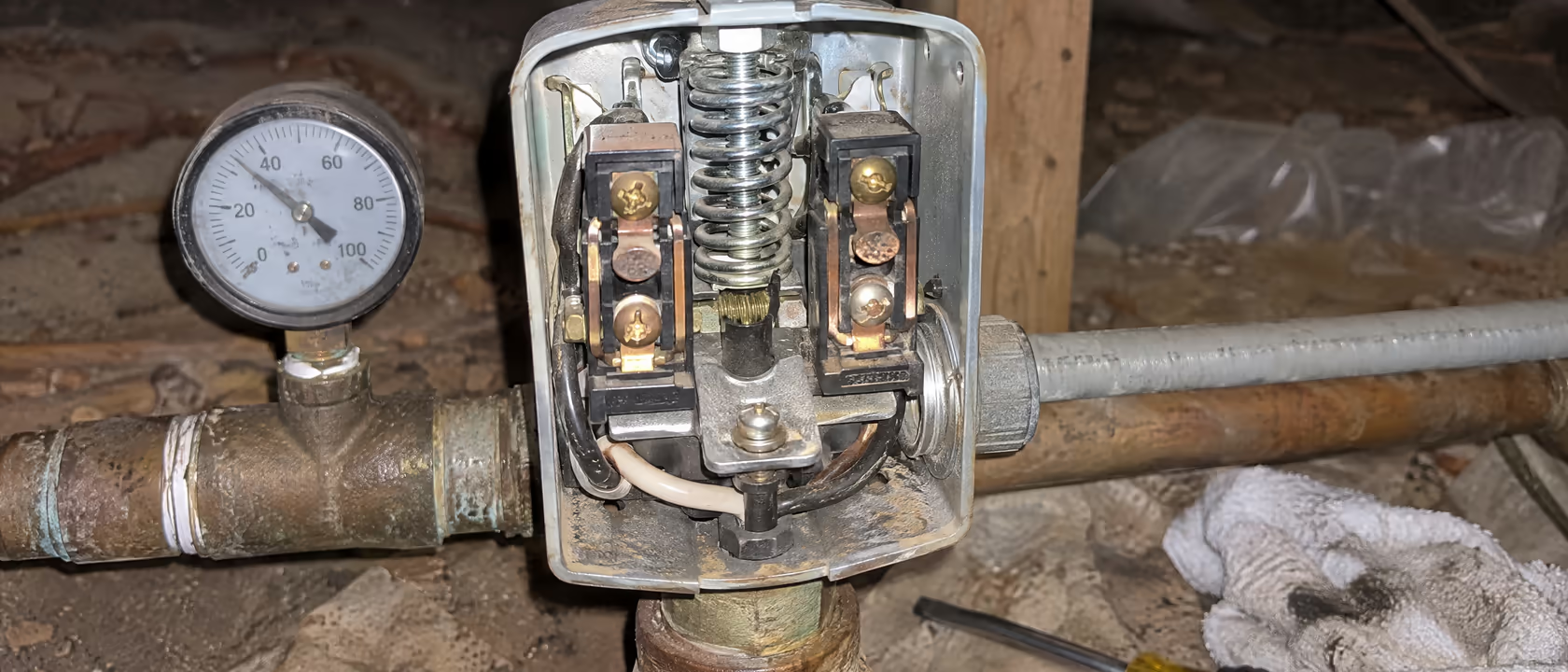
Your switch was set low and left there
Plenty of systems here run at 30/50 psi. That was the factory setting on the switch somebody fitted. Moving you to 40/60 psi is a screw adjustment on a Square D Pumptrol and takes minutes. But only if your pump and tank can carry the higher setting. We check both before touching the nut, because raising it on a tired pump buys you pressure now and a dead motor later.
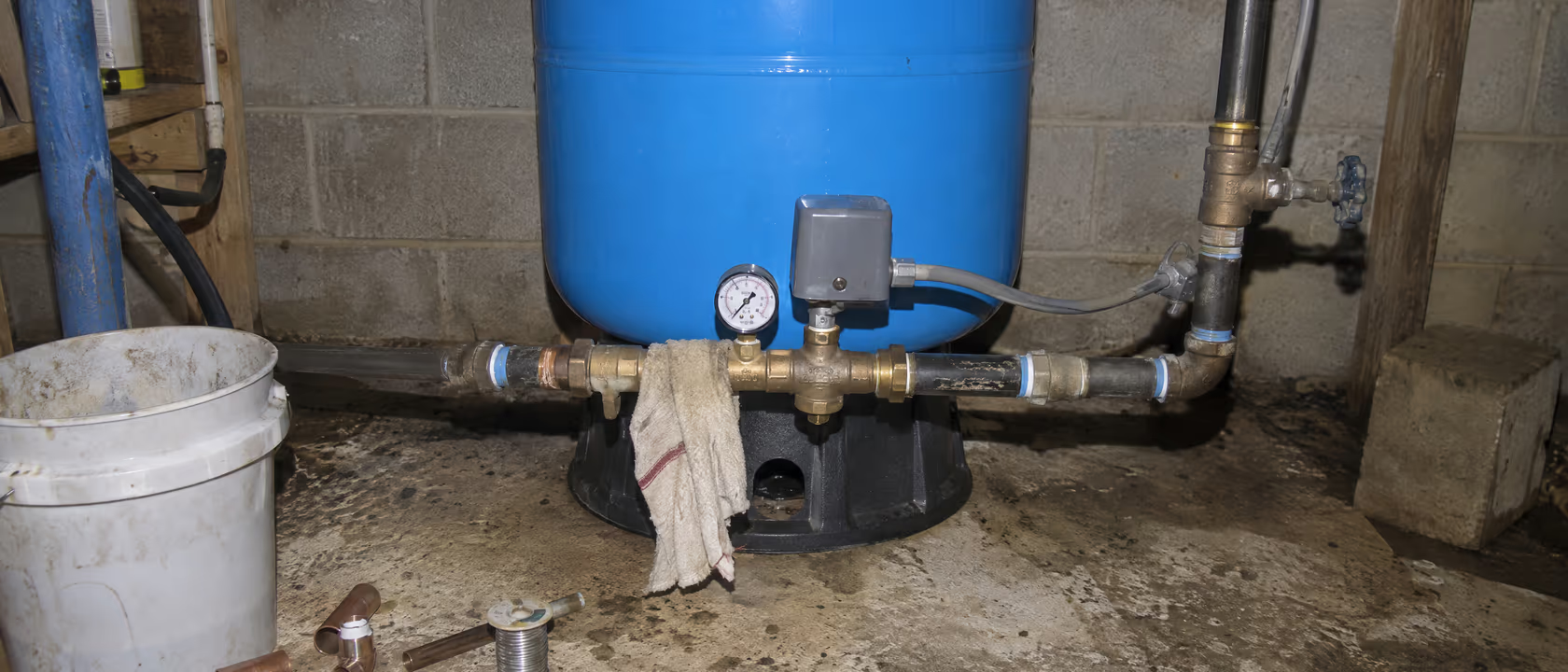
Your tank has lost its air charge
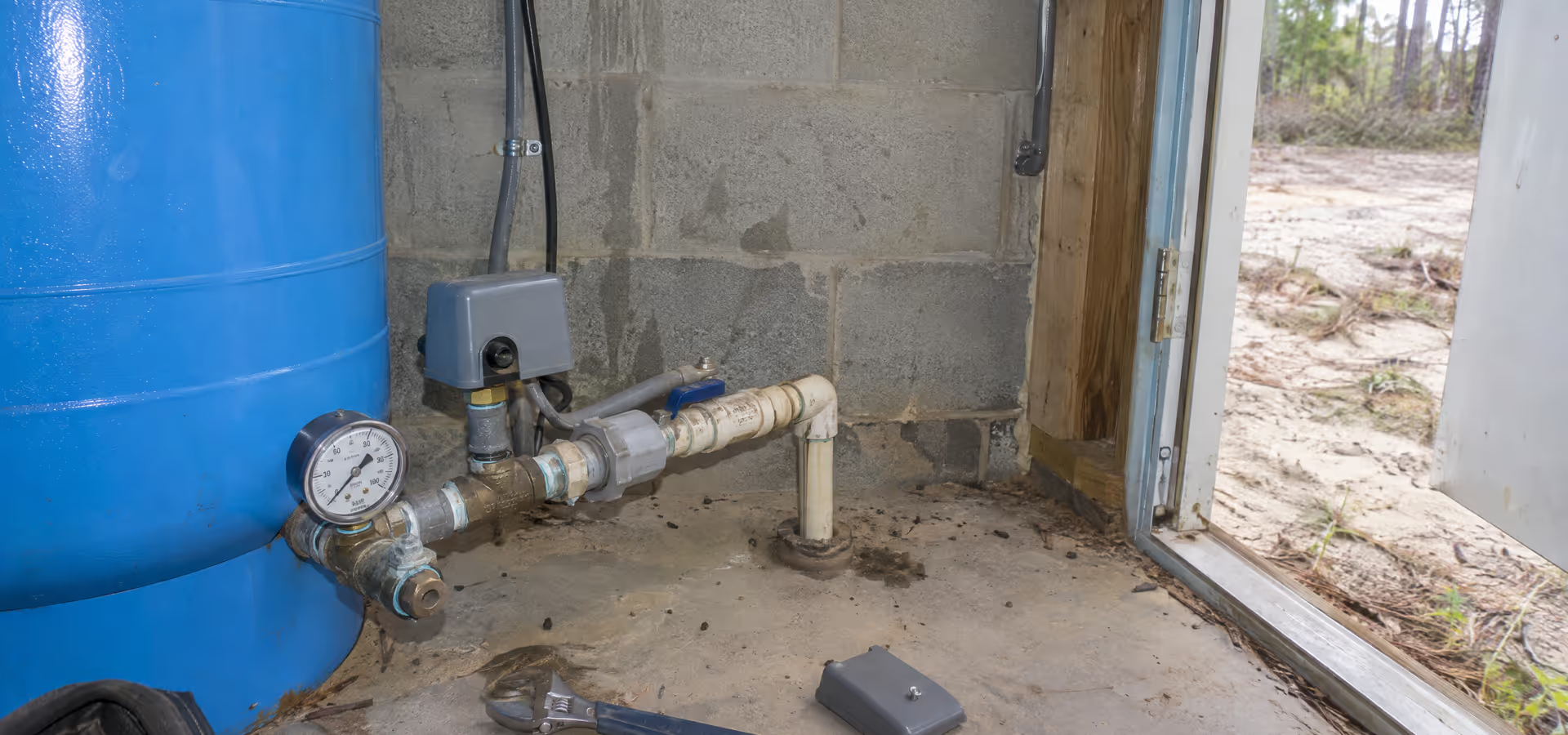
An Amtrol Well-X-Trol holds air behind a rubber diaphragm. That air leaks away slowly over years. Set right, it sits 2 psi below cut-in. Once it drops, the water your tank can actually deliver collapses. The pump starts sooner and pressure sags between cycles. We check it with a tire gauge on a drained tank. It is the most skipped step at a routine service and it costs nothing to look.
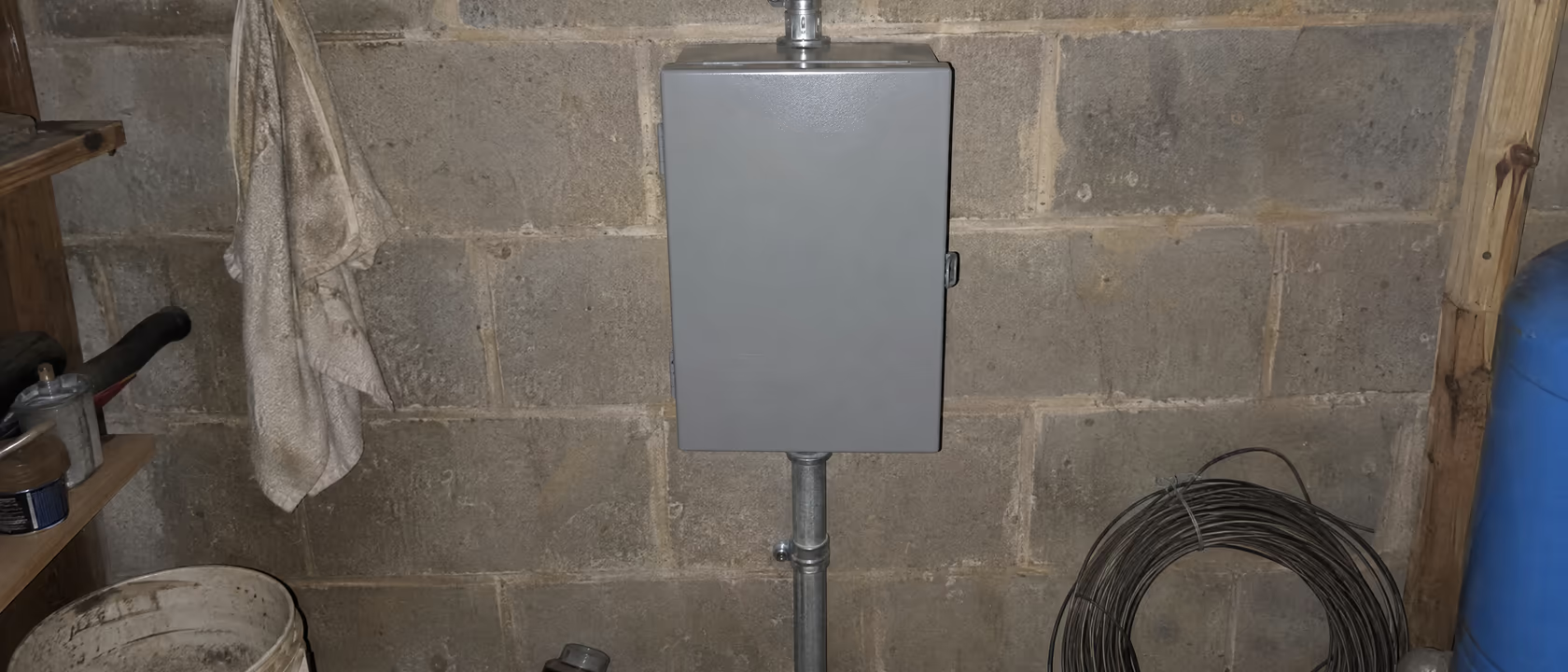
Fine alone, weak with two taps running
This is a supply and sizing problem rather than a broken part. Your pump keeps up with one fixture but cannot hold pressure across two. A Grundfos SQE or a Cycle Stop valve both hold steady pressure as demand changes. The Cycle Stop valve is far cheaper and fits your existing pump. We pick between them on a drawdown test, not a catalog.
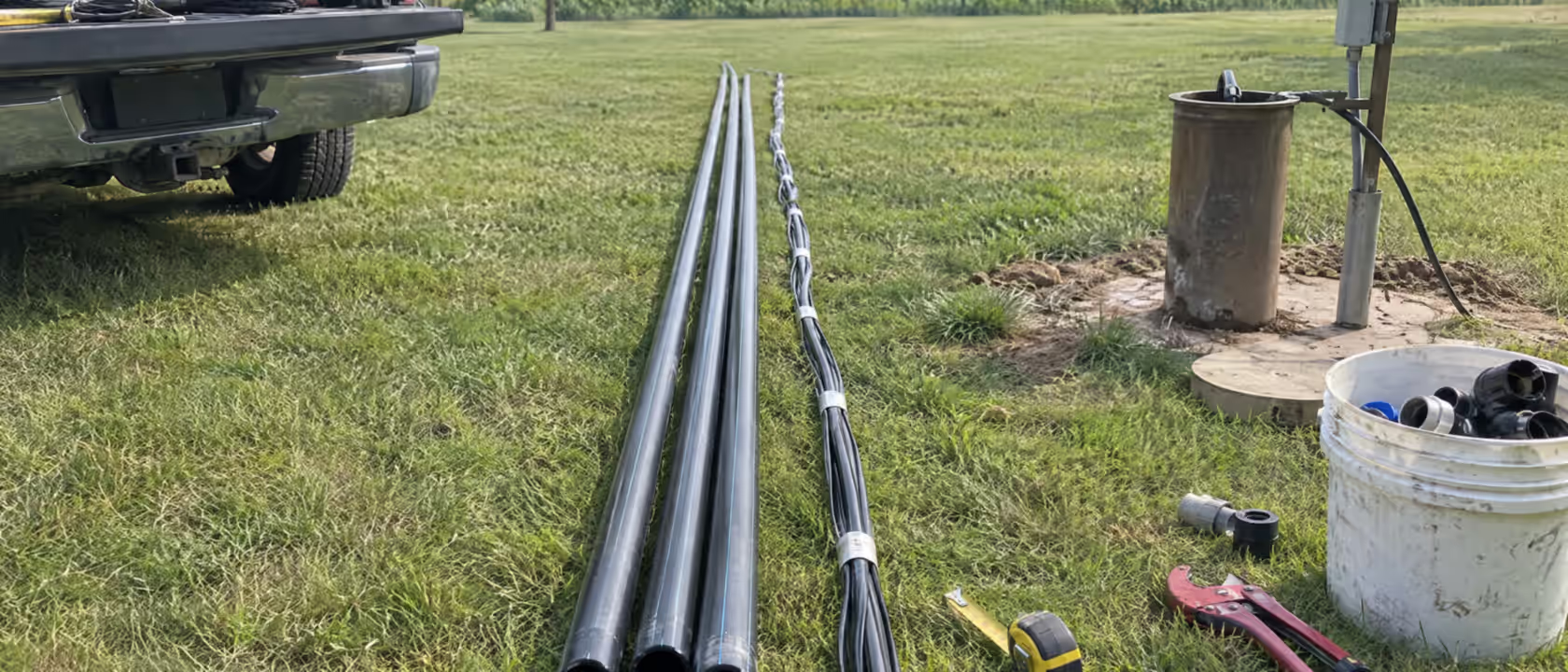
Weak everywhere, all the time
Low flow at every outlet points downstream of your tank, or at the pump itself. A blocked sediment filter does it. So does iron scale narrowing an old galvanized pipe, or a worn Goulds impeller. None of them move the pressure gauge much. We measure before and after your filter housing to find the restriction instead of guessing at it.
How we work it out
-
Read the real working band
We put a gauge on your tank tee and watch a full cycle. That gives us your actual cut-in and cut-out. Plenty of systems run 8 to 10 psi below what the switch label says.
-
Drain and check the air charge
We measure the air with no water pressure on the tank. Then we set it 2 psi under cut-in. A reading taken on a pressurized tank tells you nothing at all.
-
Run a drawdown test
We run the pump 1 hour at design flow. That shows how far your water level drops under real load. Sizing off a still-water reading ignores the exact condition causing your complaint.
-
Price the fix against the cause
We price the fix against what the test actually found. A switch adjustment, a new tank, a Cycle Stop valve and a constant-pressure pump are four answers at four prices. Your result picks one, so nobody has to guess.
What to check before anyone sells you a bigger pump
More horsepower is not more pressure
A bigger motor moves more water. It does not raise the pressure your switch is set to. If the switch still cuts out at 50 psi, a bigger pump just reaches that number faster and stops. Horsepower answers a volume problem, which is why selling it against a pressure complaint is the wrong tool sold with confidence.
Your well record sets the ceiling
Static water level and total depth on your well record decide how much lift you have to work with. A house drawing from 210 ft has different headroom than one drawing at 90 ft. No adjustment at your tank changes that arithmetic.
Weak flow can be a water problem
Iron and hardness build up inside your pipes and narrow them over years. NGWA guidance puts a full chemical panel at every three years on a private well. We run one before anyone repipes your house, because treating the water and replacing the pipe are priced very differently.
Numbers worth knowing
| Standard pressure band | 40/60 psi |
|---|---|
| Tank pre-charge | 2 psi below cut-in |
| Pressure lost per story | About 5 psi |
| Vertical lift per psi | 2.31 ft |
| Drawdown test | 1 hour at design flow |
| Switch adjustment | $150 to $500 |
Well pump work in Fayetteville runs $150 to $3,500 for most homes. What decides the number is whether the fault sits outside the well or in it, and how deep the pump hangs.
| What the job is | Typical range | Unit |
|---|---|---|
| External component: pressure switch, control box, wiring, primingThe pump itself is fine. Cheapest outcome and the most common one. | $150 – $500 | installed |
| Pressure tank replacementTank, tank tee, gauge, switch and fittings, sized on drawdown. A waterlogged tank is what makes a pump short-cycle. | $1,000 – $2,300 | installed |
| Shallow well or jet pump, to about 25 ftCommon on Coastal Plain sand wells, where the water table sits high enough that a jet pump still works. | $600 – $1,400 | installed |
| Deep submersible pump, well 100 to 200 ftTypical Fayetteville well depth. Price covers pulling the old pump, drop pipe and wire. | $1,500 – $2,500 | installed |
| Deep submersible pump, well 300 to 400 ft or higher horsepowerDepth drives horsepower and hoist labor together. Every extra 100 ft adds roughly $500 to $1,000 in pipe, wire and time. | $2,800 – $5,500 | installed |
| Full system replacement: pump, tank, wiringWorth doing together when the pump is original and the tank is the same age. | $3,500 – $6,000 | installed |
What moves the number
- Every additional 100 ft of well depth+$500 to $1,000
- Emergency, weekend or after-hours call+25% to 50%
Nobody calls about pressure until the second shower of the morning. That is the test that matters, and it is the one nobody runs before quoting.Cumberland County, NC
Who we work for
- Well and Pump Service for Farms Stock water, wash-down, irrigation and a farmhouse on one well. Sized on sustained draw, not acreage.
- Well Service for Mobile Home Parks Shared supply with tenants attached. Past 15 connections it stops being a private well at all.
- Well Service for Churches and Camps Idle most of the week, then a full building. The hardest duty cycle in private water supply.
Want it priced properly?
On-site estimates are free, itemized, and written down before any work starts.
Questions we get asked
What water pressure should a well system hold?
40/60 psi is the standard band for a house on a private well, and 30/50 psi is the setting that produces most weak-shower complaints. The jump between them is a screw adjustment when the pump and tank can carry it.
Why does my pressure drop when someone else turns on a tap?
2 psi of pre-charge error is enough to shrink usable drawdown to the point where a second fixture empties the tank before the pump catches up. It reads as a pump problem and is usually a tank problem.
Will a bigger pump fix low water pressure?
1 extra horsepower raises flow rate, not the cut-out pressure the switch enforces, so a larger pump reaches the same 50 psi faster and shuts off at the same place. Volume problems and pressure problems have different answers.
How much does it cost to fix low pressure from a well?
$150 to $500 covers a switch adjustment or replacement, which resolves a large share of these calls. A pressure tank runs $1,000 to $2,300 installed, and a constant-pressure conversion sits above both.
Who fixes low water pressure from a well near me?
Fayetteville Well Pump Repair handles low-pressure diagnosis on private wells across Fayetteville and Cumberland County, starting with the switch band, the tank pre-charge and a drawdown test before any component is quoted.
Can low pressure mean the well is running out of water?
1 hour of drawdown testing separates the two. A well losing level under load recovers slowly after the pump stops, while a settings or storage fault recovers immediately, and the recovery curve is the tell.
Weak pressure is the complaint most often answered with the most expensive part. The band, the pre-charge and the drawdown together explain the overwhelming majority of these calls, and all three are measured in under an hour. If the answer turns out to be storage rather than settings, pressure tank replacement runs $1,000 to $2,300 installed. If the switch is the culprit, pressure switch replacement is cheaper still.