Short cycling means your pump turns on and off every few seconds. You hear it as rapid clicking from the pressure switch. It kills more pumps around here than old age does. At Fayetteville Well Pump Repair, we fix the storage side that causes it. That usually costs you the price of a tank, $1,000 to $2,300, instead of the price of a pump at $1,500 to $2,500. Both figures are on our well pump cost page.
Starting is what damages a motor, not running. Every start pulls several times the normal current through the windings. A pump built for a handful of starts an hour is getting several a minute. The damage stacks up fast. A submersible rated for 8 to 15 years can be finished inside two.
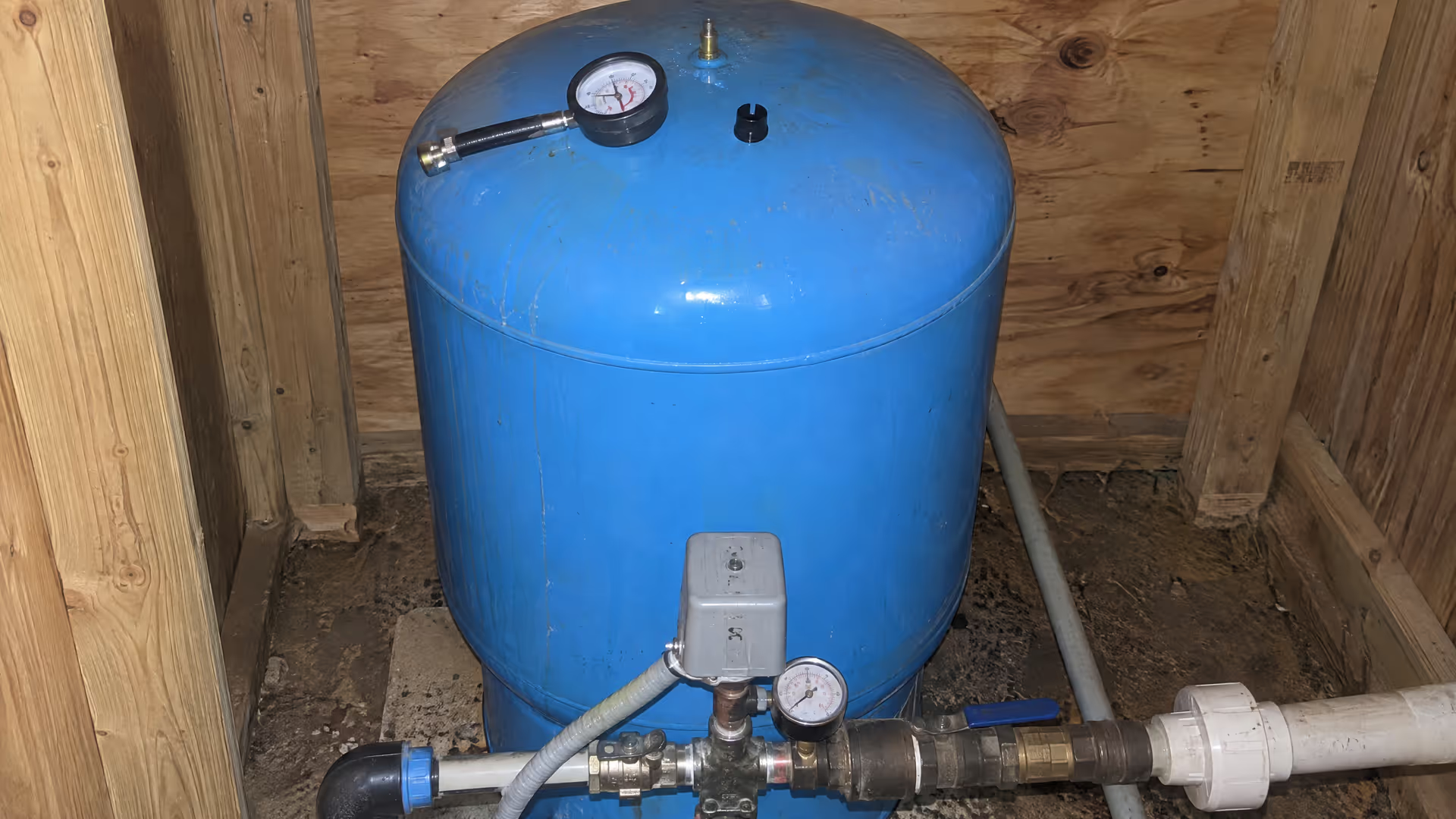
Your pressure tank is almost always the cause. The tank is not a bucket of water. It works like a spring. Air behind a rubber diaphragm holds pressure while water leaves your system, and the pump only starts once that pressure is spent. Lose the air and there is nothing left to spend. So your pump starts and stops on the few cups of water sitting in the pipes.
What is actually wrong
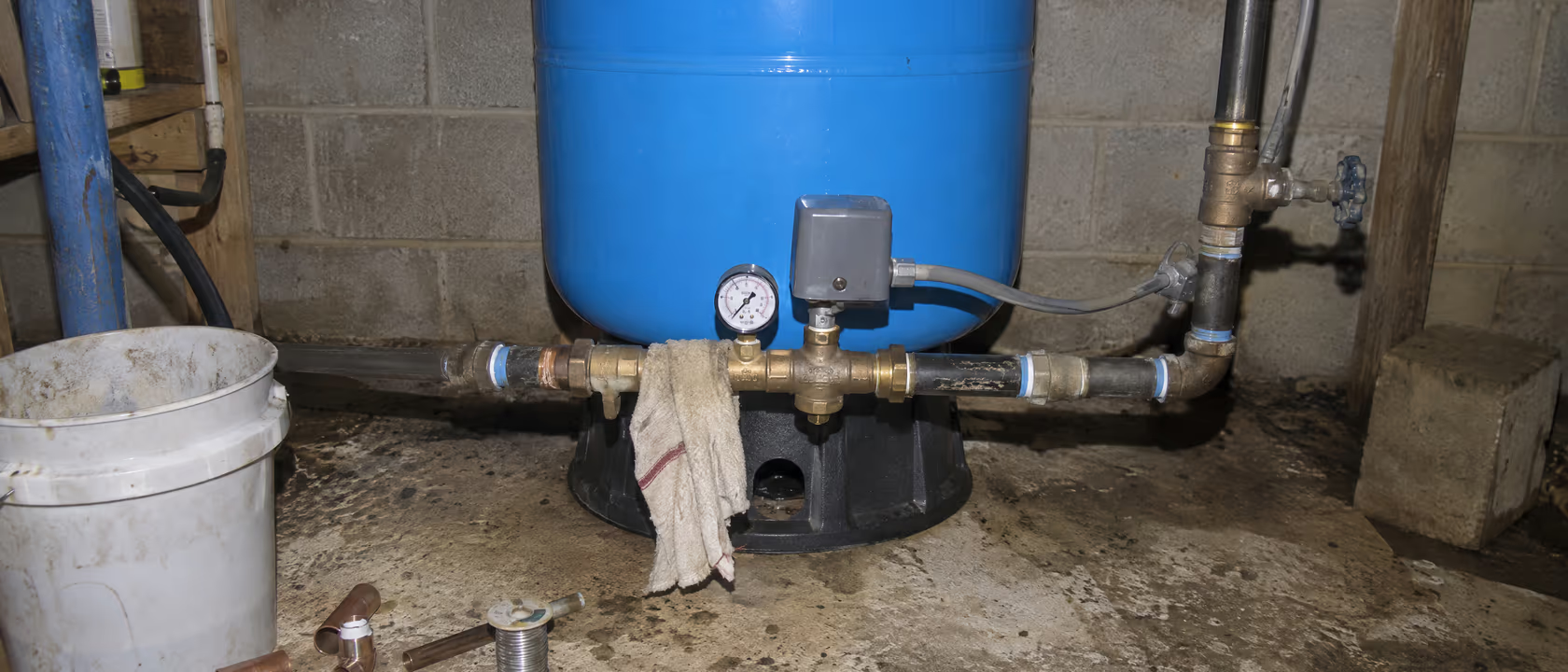
Your tank has waterlogged
The rubber diaphragm split and water filled the air side. A waterlogged tank holds no usable water at all. The tell is weight. An Amtrol Well-X-Trol that should feel light at the top rings solid when we tap it. Air at the little valve on top means the charge is simply low and we can recharge it. Water at that valve means your tank is finished.
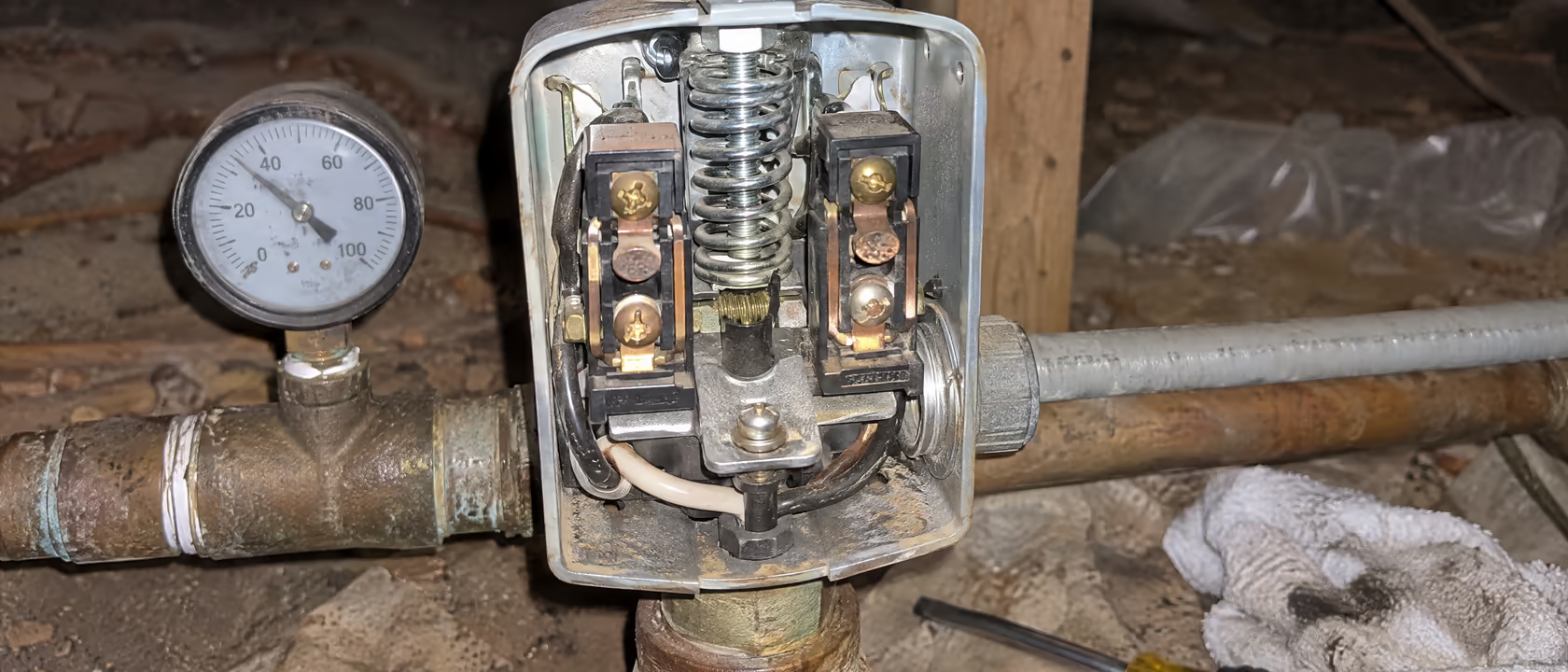
The air charge was never set right
Tanks arrive from the factory at a charge that rarely matches the switch they end up behind. Correct is 2 psi below cut-in, measured with the system drained. Get it wrong and your tank holds less water without anything actually breaking. This is the most common install fault we find on tanks fitted in the last five years.
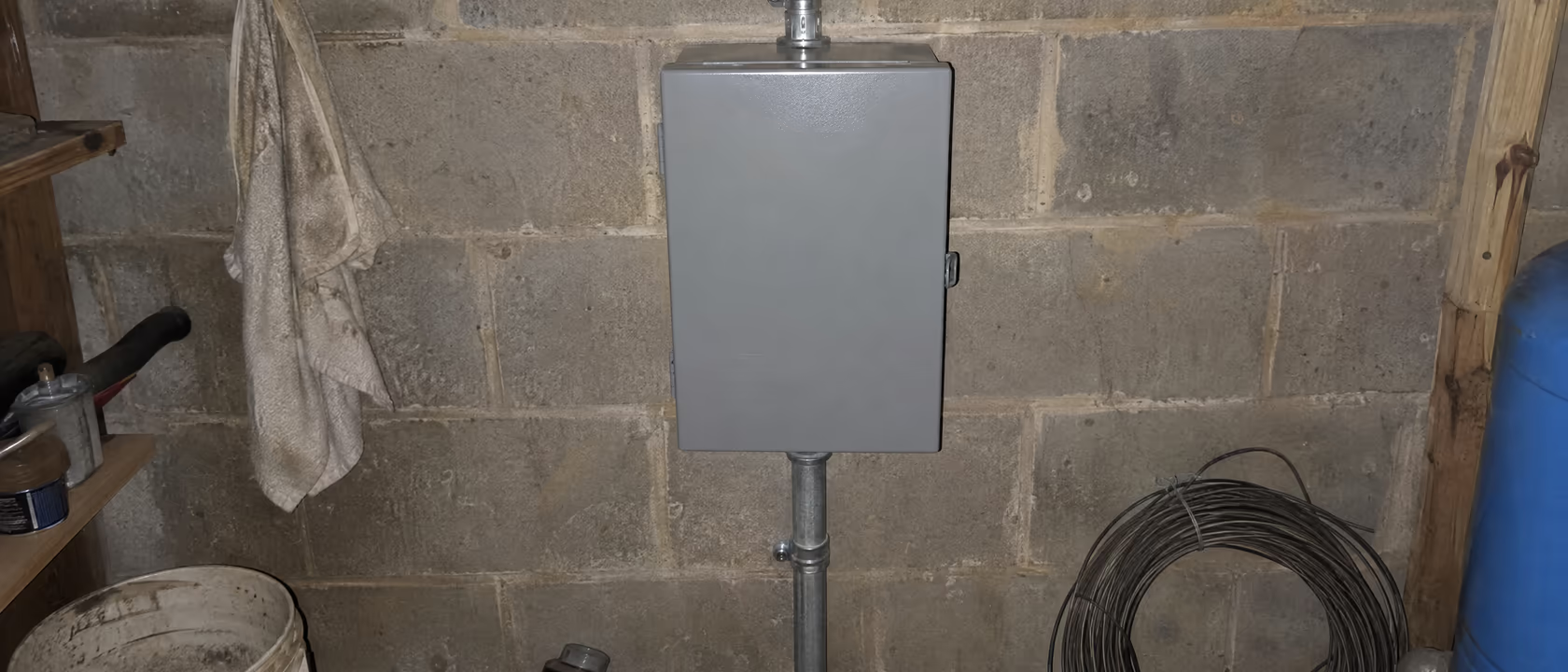
The switch differential is set too narrow
A Square D Pumptrol has two adjustments. The differential sets how far pressure falls before your pump restarts. Narrow it to a few psi and the pump cycles constantly, even behind a healthy tank. We widen it back to a 20 psi spread across a 40/60 band. That fixes it with no parts at all.
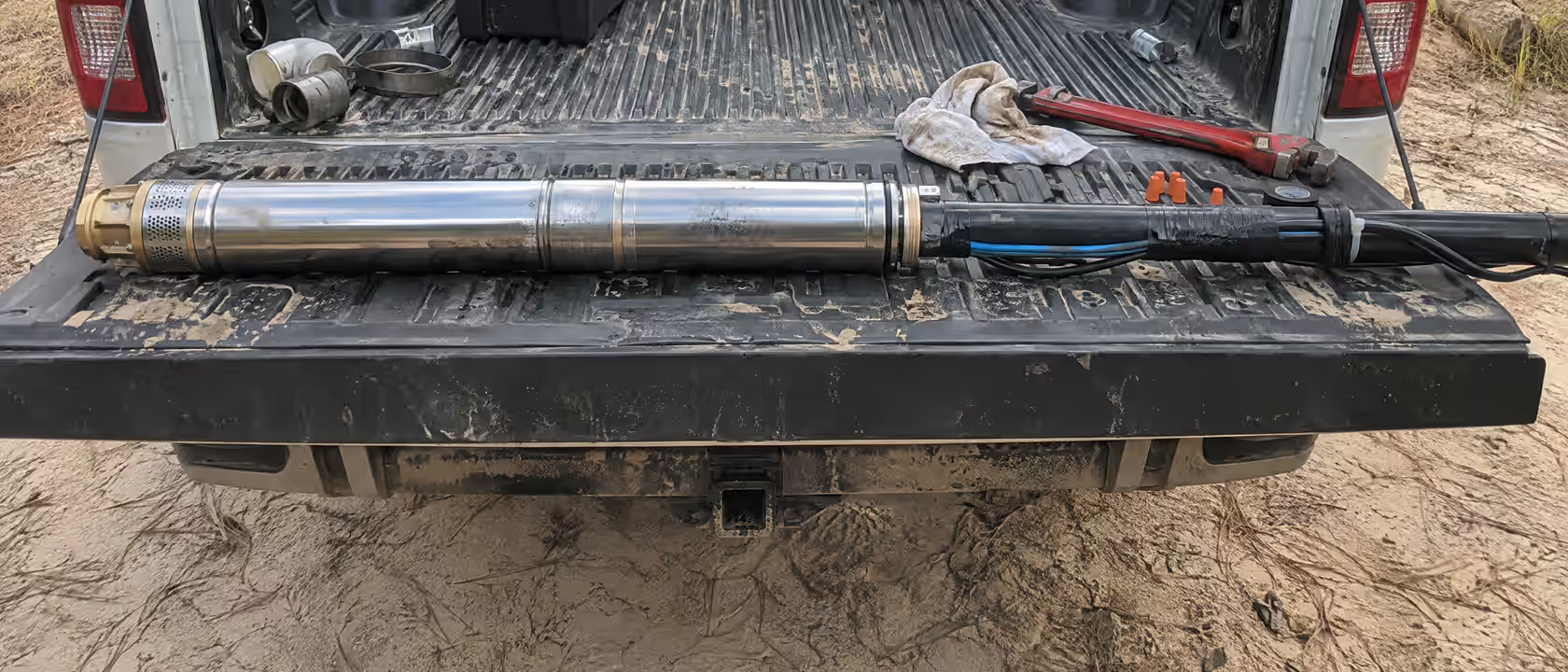
Your pump was sized to the casing, not the well
A 1 HP pump in a well that yields a fraction of its rating empties the water column faster than the ground refills it. Then it cycles while it waits. That is a sizing mistake rather than a broken part, which is why we fit a Cycle Stop valve or a correctly matched Flint & Walling replacement rather than a bigger motor.
How we work it out
-
Count the cycle
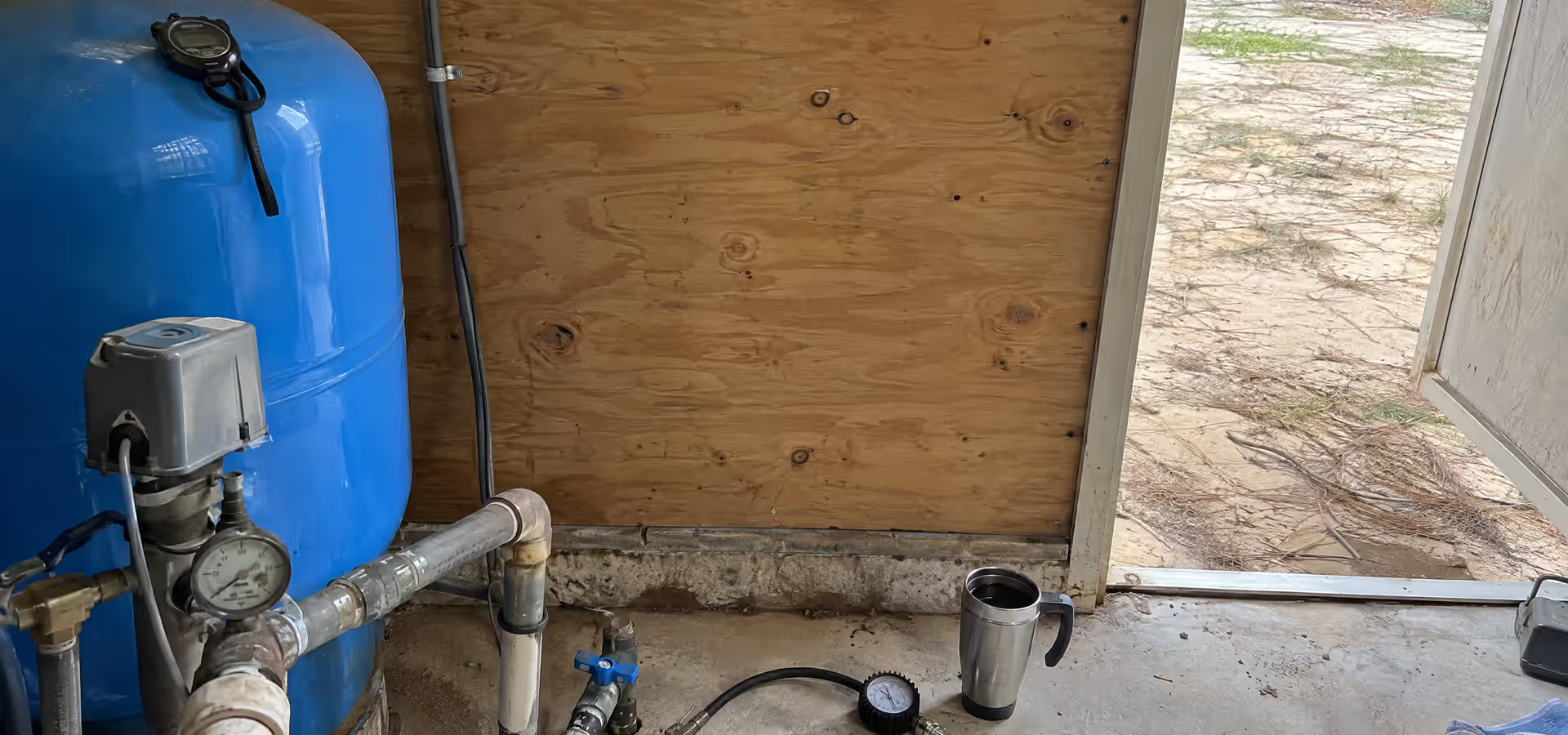
We time the gap between starts with one faucet running. That gives us the real usable water in your tank. Under 60 seconds and your tank is not doing its job, whatever the gauge says.
-
Drain and read the air side
We kill the pressure, drain the tank and put a gauge on the valve. Air means we recharge it. Water means you need a new tank. The test takes about five minutes.
-
Set the charge to the switch
We set the air charge against your actual cut-in, not the label. A tank charged for 30 psi sitting behind a 40 psi switch short cycles from the day it is fitted.
-
Check what the cycling already cost you
We test the Franklin Electric motor once the tank is fixed. A motor that has been cycling for a year may already be on borrowed time. That is worth knowing before you sign the invoice, not after.
Why this fault is worth fixing the same week
Starting current is the damage
Windings heat up on every start and cool down while running. Cycling takes away the cooling and keeps the heating. So the insulation breaks down on a clock set by starts rather than hours. That is why a four-year-old pump can die while a twenty-year-old one down the street runs fine.
A new pump on an old tank fails twice
Replacing a short-cycled pump without fixing your tank puts a new motor straight back into what killed the last one. Any estimate for a pump on a cycling system should say what the tank air charge measured. Otherwise you are being sold the same failure on repeat.
The well record shows if it was ever right
Yield and depth on the well record filed with NC DEQ decide what pump your well can carry. If the record shows a modest yield and someone fitted a pump rated well above it, the cycling was built in on install day. No adjustment at the tank fully removes it.
Numbers worth knowing
| Correct pre-charge | 2 psi below cut-in |
|---|---|
| Healthy cycle spacing | Over 60 seconds |
| Typical band spread | 20 psi |
| Waterlogged tank test | Air at the Schrader valve |
| Tank replacement | $1,000 to $2,300 installed |
| Expected pump life | 8 to 15 years |
Well pump work in Fayetteville runs $150 to $3,500 for most homes. What decides the number is whether the fault sits outside the well or in it, and how deep the pump hangs.
| What the job is | Typical range | Unit |
|---|---|---|
| External component: pressure switch, control box, wiring, primingThe pump itself is fine. Cheapest outcome and the most common one. | $150 – $500 | installed |
| Pressure tank replacementTank, tank tee, gauge, switch and fittings, sized on drawdown. A waterlogged tank is what makes a pump short-cycle. | $1,000 – $2,300 | installed |
| Shallow well or jet pump, to about 25 ftCommon on Coastal Plain sand wells, where the water table sits high enough that a jet pump still works. | $600 – $1,400 | installed |
| Deep submersible pump, well 100 to 200 ftTypical Fayetteville well depth. Price covers pulling the old pump, drop pipe and wire. | $1,500 – $2,500 | installed |
| Deep submersible pump, well 300 to 400 ft or higher horsepowerDepth drives horsepower and hoist labor together. Every extra 100 ft adds roughly $500 to $1,000 in pipe, wire and time. | $2,800 – $5,500 | installed |
| Full system replacement: pump, tank, wiringWorth doing together when the pump is original and the tank is the same age. | $3,500 – $6,000 | installed |
What moves the number
- Every additional 100 ft of well depth+$500 to $1,000
- Emergency, weekend or after-hours call+25% to 50%
Short cycling does not break a pump on the day you notice it. It broke it eighteen months ago and has been collecting since.Cumberland County, NC
Who we work for
- Well and Pump Service for Farms Stock water, wash-down, irrigation and a farmhouse on one well. Sized on sustained draw, not acreage.
- Well Service for Mobile Home Parks Shared supply with tenants attached. Past 15 connections it stops being a private well at all.
- Well Service for Churches and Camps Idle most of the week, then a full building. The hardest duty cycle in private water supply.
No water this morning?
Tell us what the pump is doing and we will tell you what it costs to put right.
Questions we get asked
What causes a well pump to short cycle?
9 times out of 10 it is the pressure tank, either a failed diaphragm or a pre-charge that was never set correctly. The narrow band on a pressure switch and an oversized pump account for most of the rest.
How fast is too fast between pump starts?
60 seconds is the rough floor with a single fixture running. Anything under that means usable drawdown has collapsed, and at intervals of a few seconds the motor is being damaged on every start.
How much does it cost to stop short cycling?
$150 to $500 covers a recharge or a switch adjustment where the tank is still sound. A replacement tank runs $1,000 to $2,300 installed, which is still well under the $1,500 to $2,500 a burnt submersible costs.
Can short cycling damage the pump permanently?
8 to 15 years of expected life can drop to under two. Damage accumulates on start current, so the clock runs on cycles rather than on hours, and it is not recoverable once the winding insulation has gone.
Who fixes a short cycling well pump near me?
Fayetteville Well Pump Repair services short-cycling systems across Fayetteville and Cumberland County, checking the tank pre-charge and the switch differential before any pump is quoted.
Should I replace the tank or the pump first?
2 psi of pre-charge error explains most cycling, so the tank side is tested first every time. Fitting a pump to a cycling system without correcting storage returns the new motor to the exact condition that ended the old one.
Rapid clicking is one of the few well faults that gives real warning before the expensive failure arrives. A pre-charge check costs nothing on a service visit and a tank costs a fraction of a submersible, which makes this the cheapest well repair to catch early and one of the most expensive to ignore. Pressure tank replacement covers the usual fix, and pressure switch replacement covers the differential side of it.