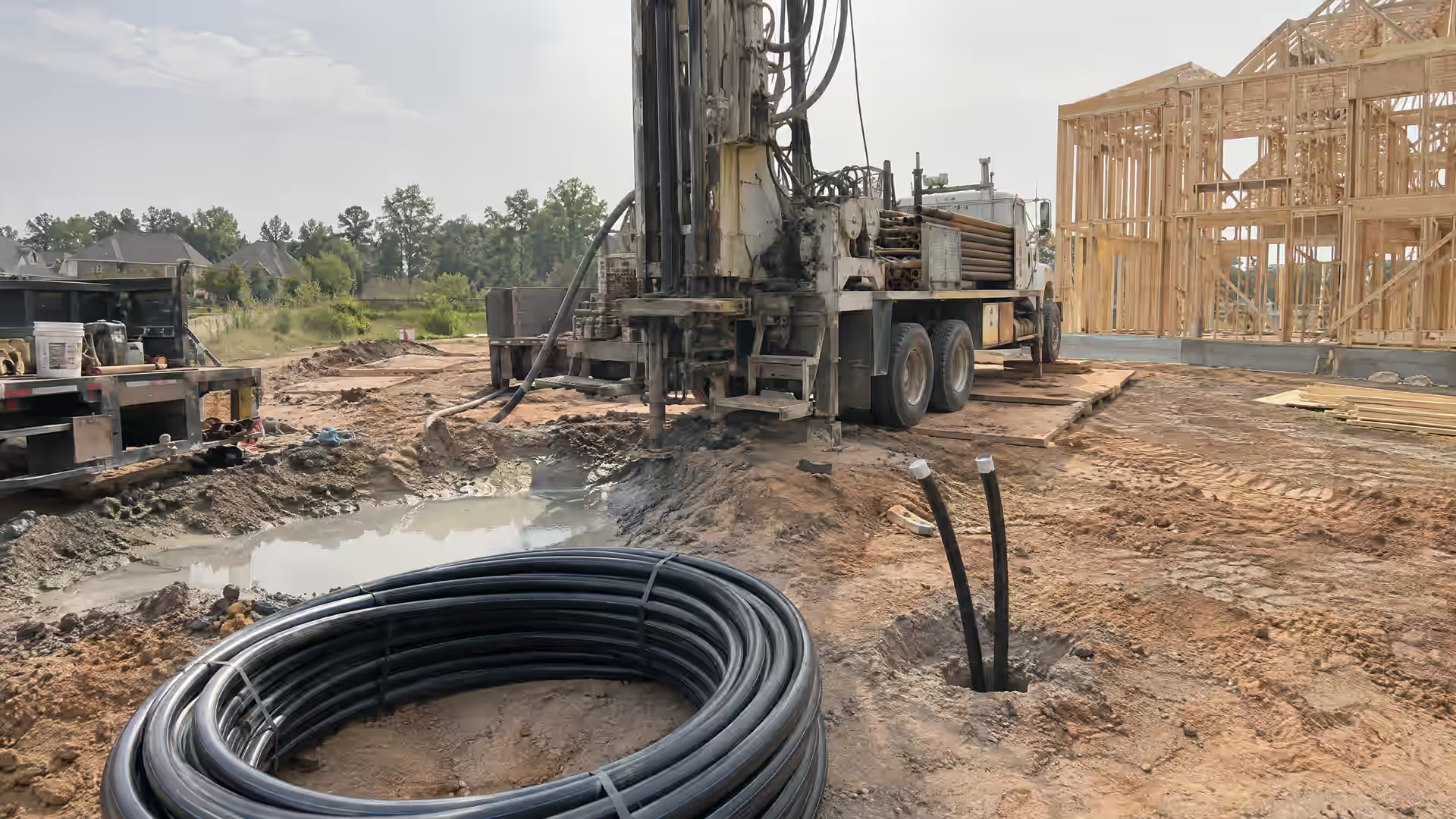
Geothermal drilling puts vertical holes in the ground for a ground source heat pump. The drilling is the same work as a water well with a different thing going down the hole. At Fayetteville Well Pump Repair, we drill and grout the bores while your mechanical contractor sizes the loop, because loop length follows your heating and cooling load rather than the ground alone. Drilling runs $28 to $60 per ft, published on our well pump cost page.
A closed loop is a sealed pipe circuit inside a grouted hole. Fluid circulates down and back up. It picks up heat from the ground in winter and dumps heat into it in summer. Nothing is taken from or put into your water supply at any point. The hole is a heat exchanger, not a water source.
What makes this work here is the same thing that keeps water wells shallow. Wet sand carries heat far better than dry ground does. So loop length calculations for this area come out differently from the same house on dry rock. A designer working from a national average is guessing, and guessing conservatively costs you footage you did not need.
What is actually wrong
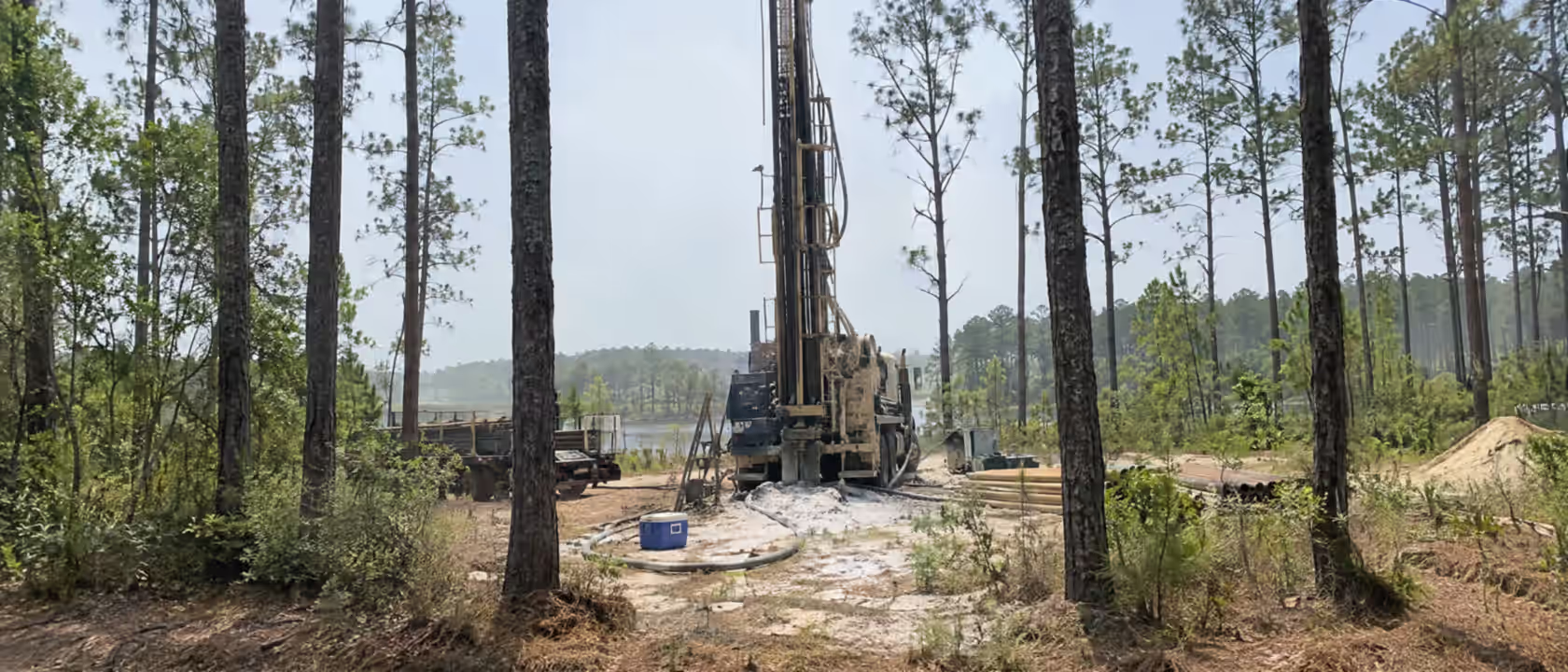
Vertical closed loop bores
This is the usual setup where your land is limited. We drill several holes, each carrying a U-bend of heavy plastic pipe, then grout them to full depth. A Grundfos circulator on the mechanical side moves the fluid, not anything in the hole. Spacing matters, because holes too close together share the same warm ground and each one then performs worse than the calculation predicted.
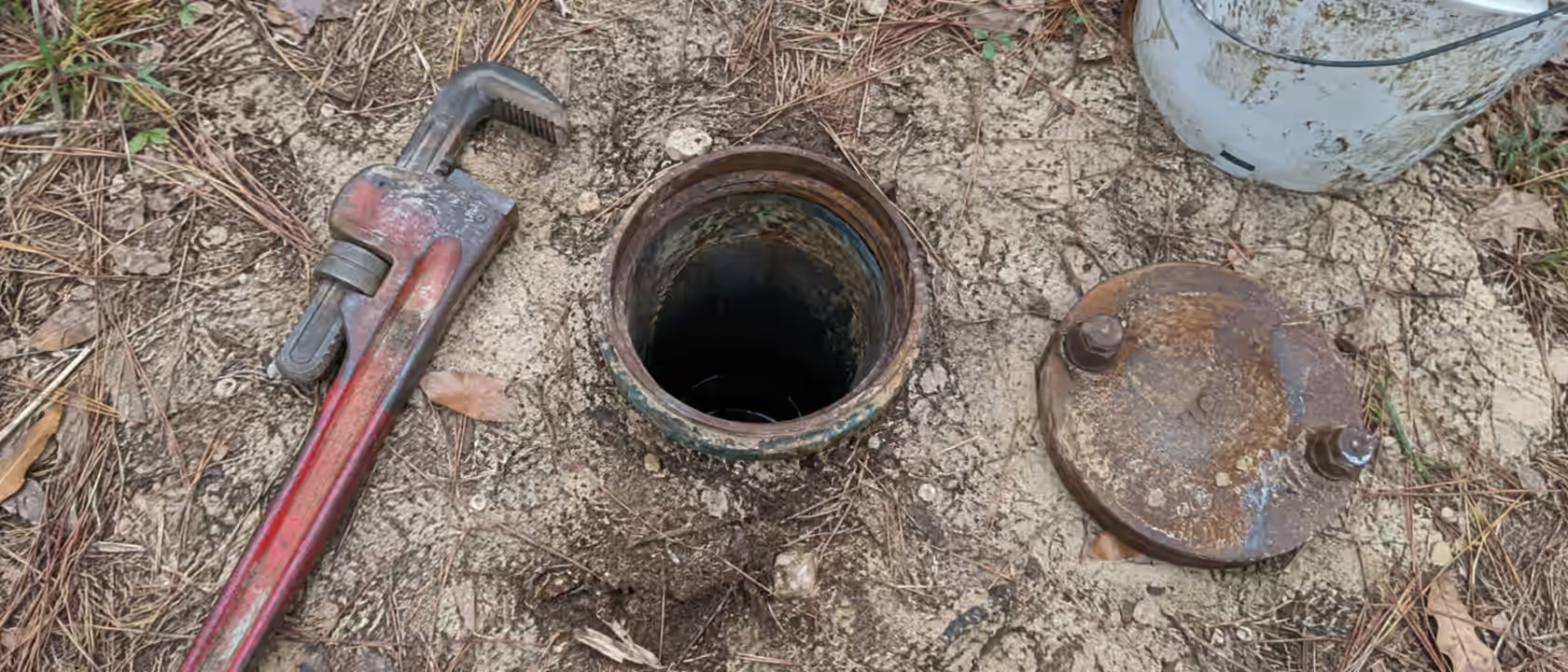
Horizontal loops where there is land
On acreage we trench a horizontal field instead of drilling. It costs less for the same capacity. It needs far more area and it tears up the ground it crosses. On a rural lot with room to spare it is frequently the better buy.
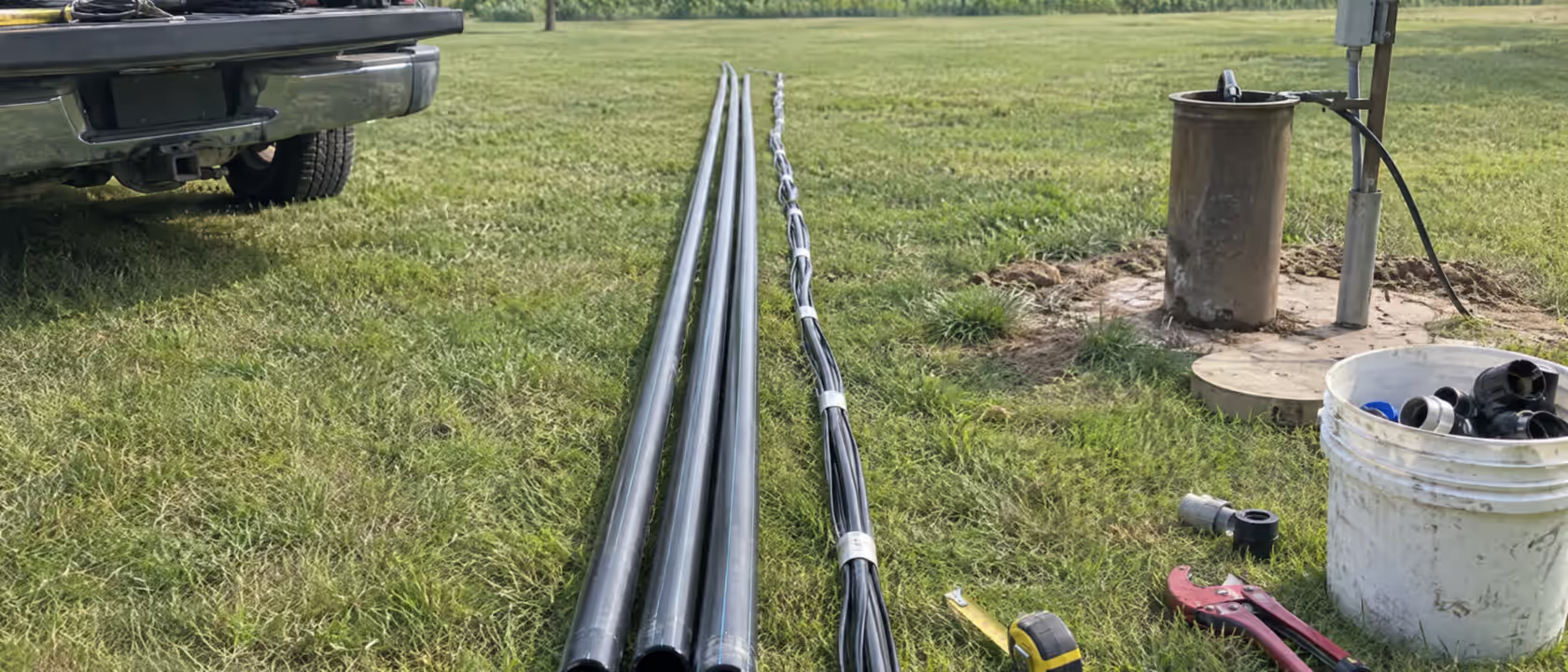
Open loop systems and why we are careful
An open loop pulls groundwater through a Franklin Electric powered submersible, runs it through the heat pump and discharges it. It works well and it eats real well capacity. That competes directly with your household water in the same August when the level is lowest. We recommend a closed loop instead, because it avoids that fight entirely.
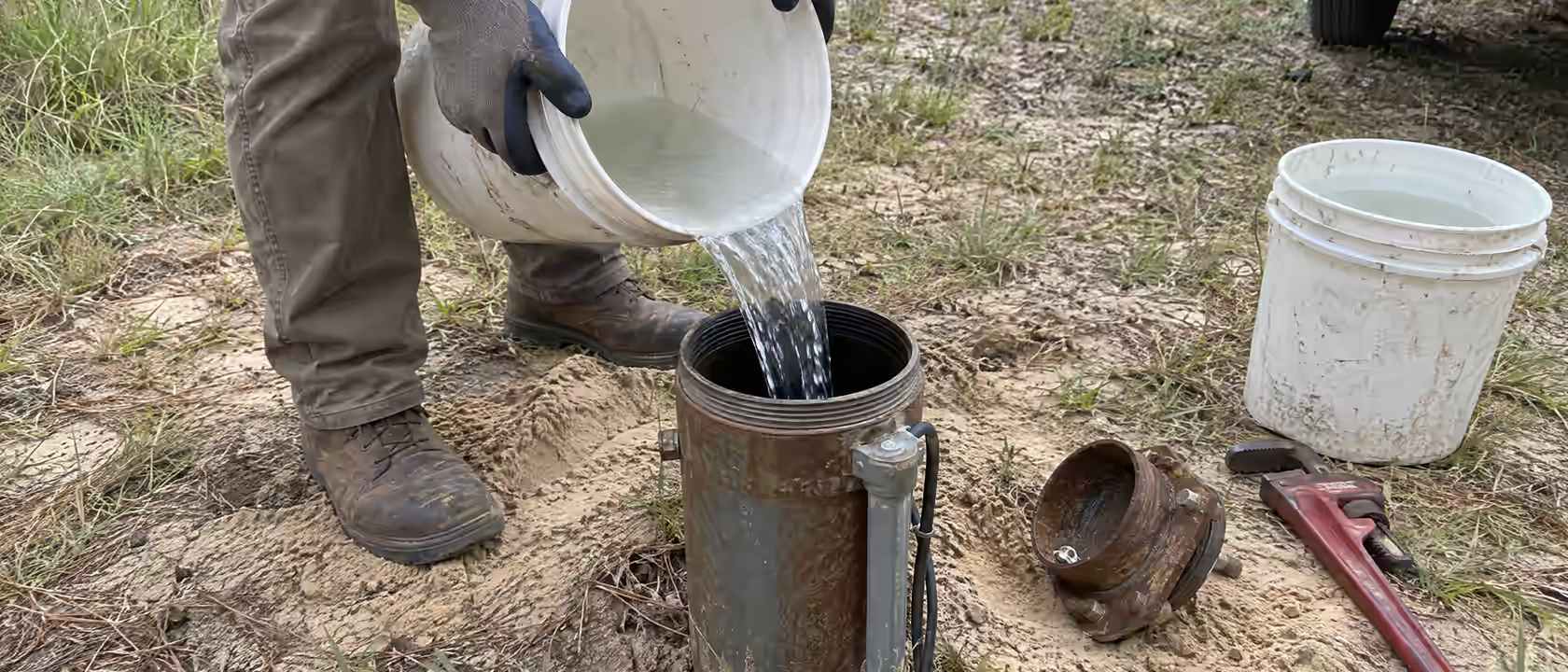
Grouting is the whole safety argument
A geothermal hole passes through the same layers a water well does. We grout to full depth so those layers stay sealed apart. Left short, it is an open pathway with a pipe in it. That is the same defect that produces coliform hits on a badly built water well.
How we work it out
-
Start from the load calculation
We start from your mechanical designer's load calculation rather than from the ground. Loop length follows the heating and cooling load that calculation produces. Drilling before that number exists is drilling to a guess and paying by the foot for it.
-
Site the holes and the setbacks
We lay the holes out against every setback before we think about depth. Spacing between holes, distance from your existing well and separation from any septic drainfield all constrain where they can go.
-
Drill and set the loops
We drill at $28 to $60 per ft, insert the loops, then pressure test them before grouting. That way a damaged pipe gets found while it can still be replaced.
-
Grout full depth and document
We place thermally enhanced grout from the base upward and record the work. A hole left ungrouted is a permanent liability under the same rules that govern water wells.
Where the rules for a geothermal bore come from
It is still a hole into your water supply
15A NCAC 02C governs construction of holes that reach groundwater. A geothermal loop qualifies even though it produces no water. Full-depth grouting is the requirement, because the pathway it creates is identical to the one a water well creates.
Records get filed
We record the construction details with NC DEQ so the holes are known to anyone working your site later. An undocumented array is a set of hidden penetrations the next contractor has no way to anticipate.
Protecting your water well while we drill
A house well on the same lot draws from the ground the array passes through. We plan separation distance and drilling order around it, including the Merrill pitless where your supply line leaves the casing. That keeps a Baker Water Systems cap sealed, and we sample the supply afterwards through the county health department.
Numbers worth knowing
| Drilling rate | $28 to $60 per ft |
|---|---|
| Loop type | Vertical closed, U-bend |
| Sizing input | Heat pump load calculation |
| Local advantage | Saturated sand conducts well |
| Grouting | Full depth, thermally enhanced |
| Pressure test | Before grouting, always |
A complete residential well in the Fayetteville area runs $6,500 to $11,500. Coastal Plain sand drills faster and shallower than the Piedmont rock an hour west, which is why the same well costs less here than it does in Raleigh.
| What the job is | Typical range | Unit |
|---|---|---|
| Complete well, Coastal Plain (Fayetteville, Cumberland County)Typical depth 100 to 250 ft. Sand aquifers drill fast and predictably. | $6,500 – $11,500 | complete |
| Complete well, Sandhills transition zoneTypical depth 150 to 350 ft. West of the county line the geology starts changing. | $8,000 – $13,500 | complete |
| Complete well, Piedmont (for comparison)Fractured crystalline rock means slow drilling and real dry-hole risk. Not our geology. | $9,200 – $16,500 | complete |
| Drilling rate, North CarolinaExtra footage to reach a reliable aquifer bills at the same per-foot rate. | $28 – $60 | per foot |
| Casing, Coastal PlainCheaper here than the $1,200 to $3,000 a Piedmont well needs. | $400 – $1,200 | installed |
| Cumberland County well permitPaid to the county health department. A house well is $320 including the inspection and the bacteria, chemistry and nitrate samples; an irrigation or agricultural well with no sample is $275, from the county fee schedule posted in 2022. Well construction cannot legally start without it. | $275 – $320 | permit |
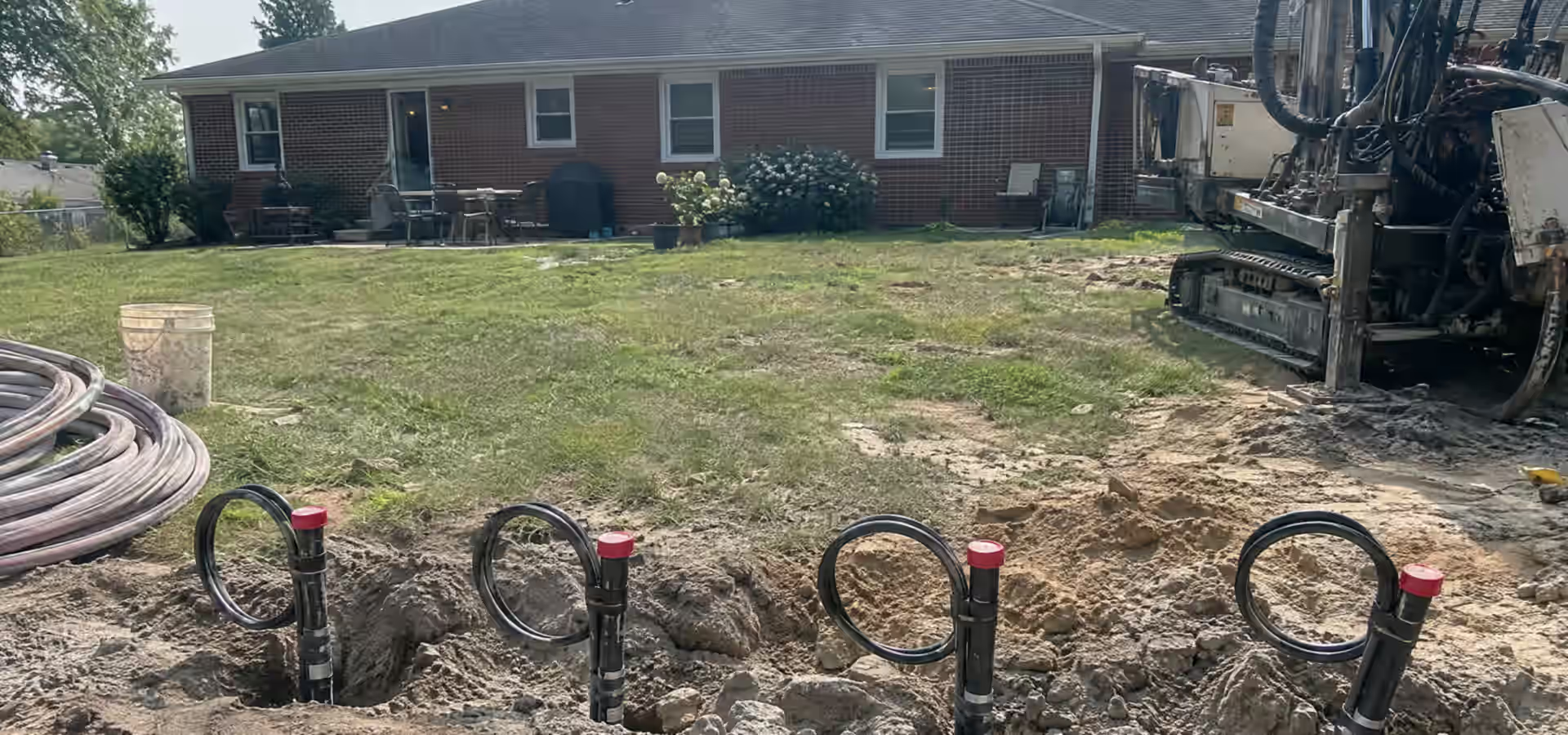
It is the same rig, the same grout and the same rules. The only difference is that nothing comes back up the hole.Cumberland County, NC
Who we work for
- Well and Pump Service for Farms Stock water, wash-down, irrigation and a farmhouse on one well. Sized on sustained draw, not acreage.
- Well Service for Mobile Home Parks Shared supply with tenants attached. Past 15 connections it stops being a private well at all.
- Well Service for Churches and Camps Idle most of the week, then a full building. The hardest duty cycle in private water supply.
Want it priced properly?
On-site estimates are free, itemized, and written down before any work starts.
Questions we get asked
How deep are geothermal bores in this area?
1 number decides it, and it is the heat pump load rather than the geology. Loop length is calculated from the heating and cooling demand, then divided across the number of bores the site can accommodate.
How much does geothermal drilling cost?
$28 to $60 per ft covers the drilling, which is the same rate as a water well. Loop pipe, grout, headers and the heat pump itself sit outside that figure and belong to the mechanical contractor.
Does a geothermal well use my groundwater?
1 loop type does and one does not. A closed loop circulates sealed fluid and takes nothing from the aquifer. An open loop draws and discharges groundwater, which competes with the household supply.
Is geothermal drilling regulated like a water well?
1 standard covers both. A bore penetrating groundwater is regulated whether it produces water or not, and full-depth grouting is required because the pathway created is the same either way.
Who drills geothermal wells near me?
Fayetteville Well Pump Repair drills and grouts vertical loop boreholes across Fayetteville and Cumberland County, working from the mechanical designer's load calculation and pressure testing loops before grouting.
Is the Coastal Plain good ground for geothermal?
1 property helps considerably: saturated sand conducts heat better than dry ground, so loop length here often works out shorter than a national average would suggest for the same building.
Geothermal drilling is a small part of a much larger mechanical project, and the part where the ground conditions and the well construction rules meet. Loop length comes from the load calculation, spacing comes from the site, and grouting comes from the same standard that governs every other bore in the county. Where there is an existing supply well on the property, water well drilling covers how the two are kept apart, and well abandonment covers what happens to any bore taken out of service.