A pump that never shuts off is burning up its motor right now. Turn the breaker off first, then call. At Fayetteville Well Pump Repair, we treat this as an emergency, because a submersible motor is cooled by water moving past it. A motor fighting a leak it can never win overheats instead. Catching it today can mean a $150 to $500 valve. Leaving it a weekend can mean a $1,500 to $2,500 pump. Pricing sits on our well pump cost page.
Your pump shuts off when the tank reaches cut-out pressure. If it never gets there, one of two things is true. Water is escaping faster than the pump can deliver it. Or the pump can no longer deliver. Those are the only two families, and we tell them apart by watching the gauge rather than by opening anything.
The needle answers it in about a minute. A needle that climbs to 45 psi and stops means your pump has worn out. A needle that will not climb, or that drops the moment the pump pauses, means water is going somewhere it should not. One of those ends at your wellhead. The other ends under a field. The cost difference is large.
What is actually wrong
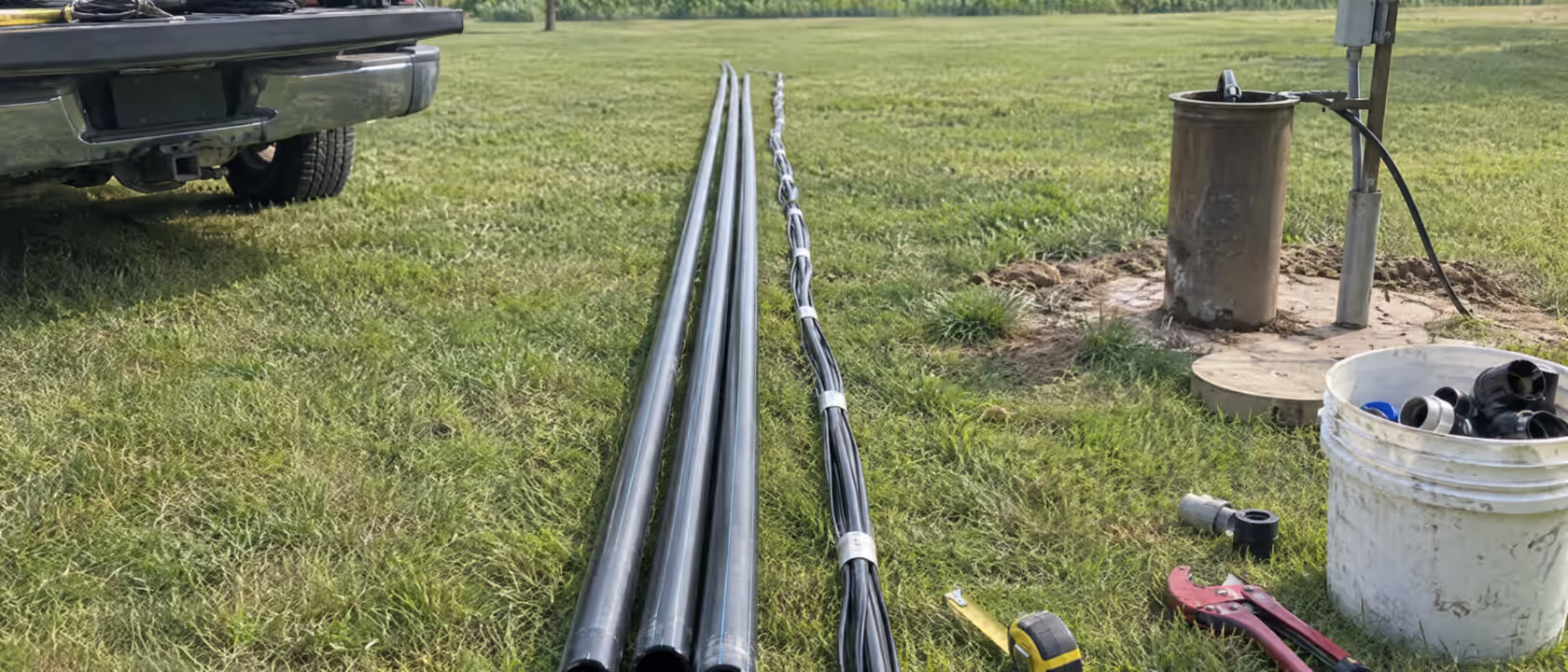
A leak between the well and the house
The buried line from your wellhead to the pressure tank can run 100 ft or more across a rural lot. It sits below frost depth and nobody has looked at it in decades. A split at a coupling bleeds nonstop and shows nothing on the surface, because Coastal Plain sand carries the water away instead of pooling it. We shut the valve at your tank and watch whether the pump settles down.
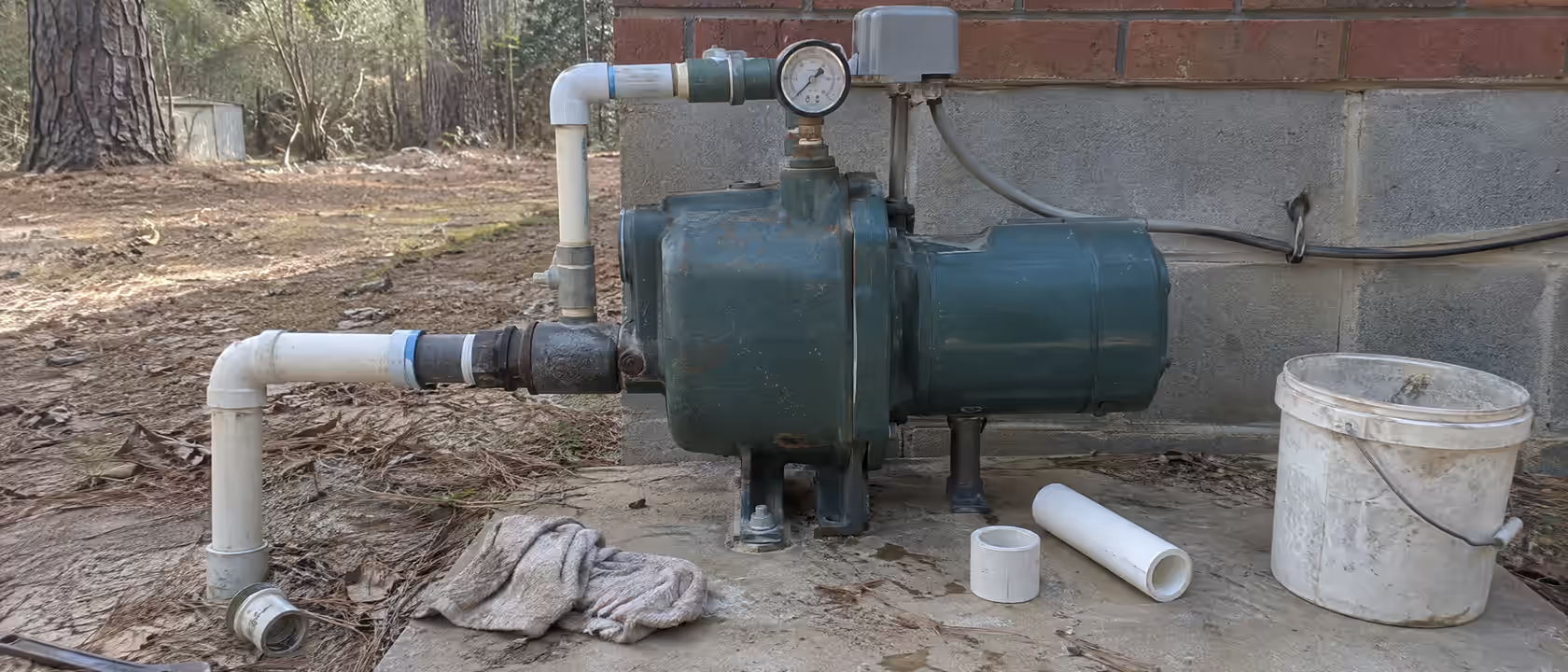
The check valve or foot valve is leaking back
A check valve holds the column of water above your pump between cycles. When the seat wears, that water drains back down the pipe and the pump restarts to lift it again. A plastic seat on a sandy well wears out fast. That is why we fit a Simmons brass foot valve instead, which outlasts the part it replaces on most properties here.
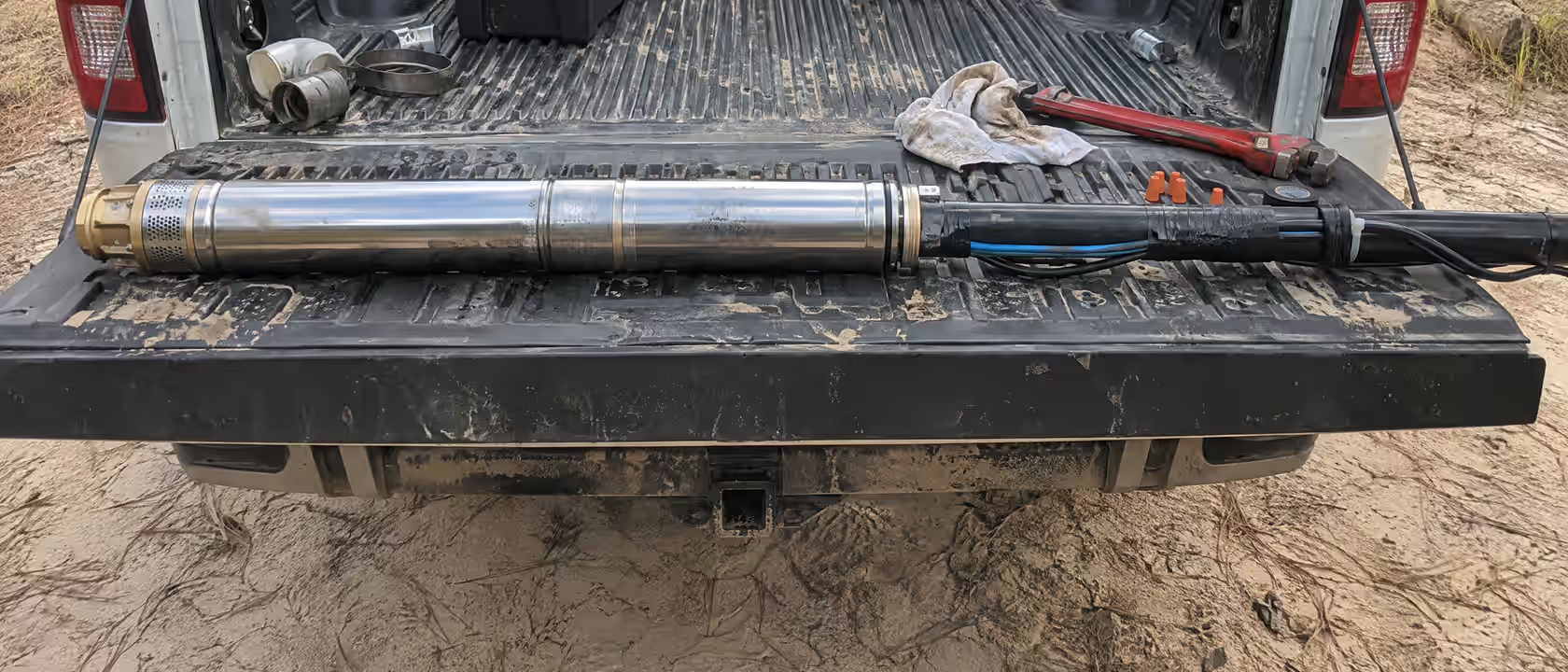
The pump is worn out and cannot reach cut-out
Impellers wear down, especially where fine sand passes through them season after season. A Goulds pump end that once made 60 psi will stall at 45 psi and hold there, running forever. The motor underneath is usually still good. So we replace the pump end rather than the whole unit when the Franklin Electric motor tests clean.
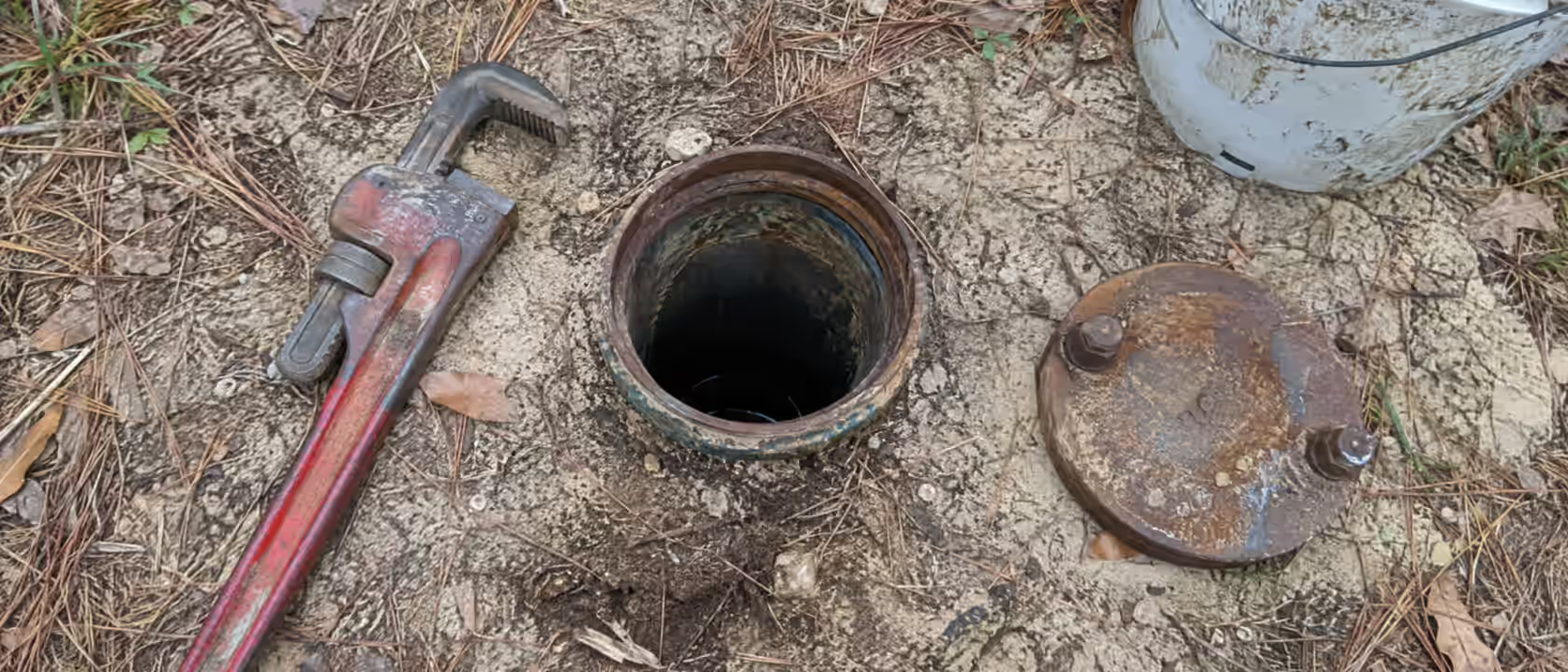
Your water level has dropped below the pump
Late summer pulls the water table down. A pump set close to the historic low starts drawing air and chasing pressure it cannot make. That is a water level problem wearing a mechanical costume. We tell them apart in an hour with your well record and a drawdown test. A well that has run dry is the far end of the same problem.
How we work it out
-
Kill the breaker first
We shut the breaker off before any testing starts. Running nonstop destroys a motor, because every extra minute of dry running turns a repair into a replacement.
-
Watch the gauge, not the pump
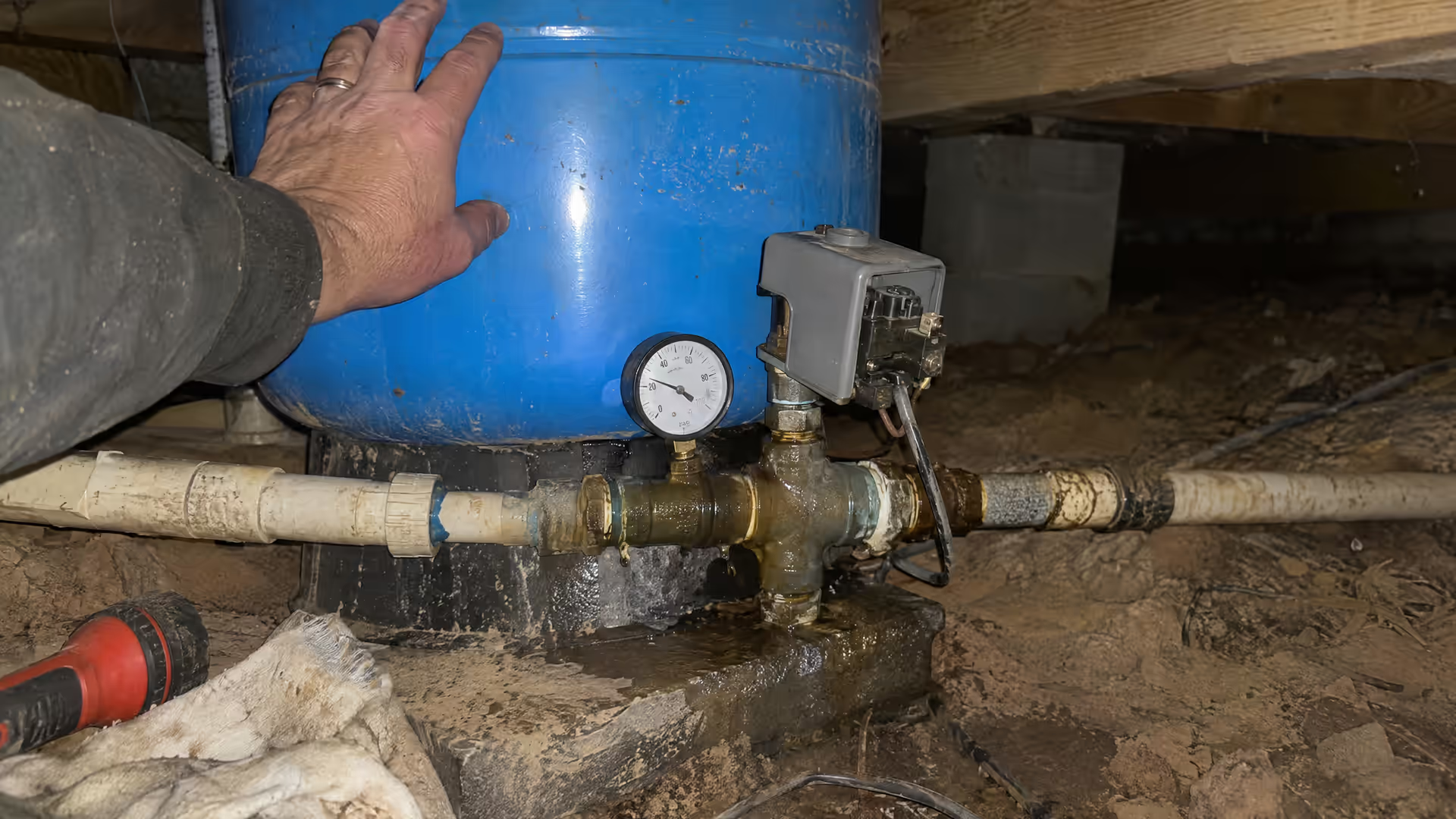
We spend a minute at your tank tee watching the gauge. Pressure that stalls partway and pressure that never climbs are two different faults. We check the Amtrol Well-X-Trol air charge first, so a flat tank does not get read as a leak.
-
Isolate the buried line and hold it
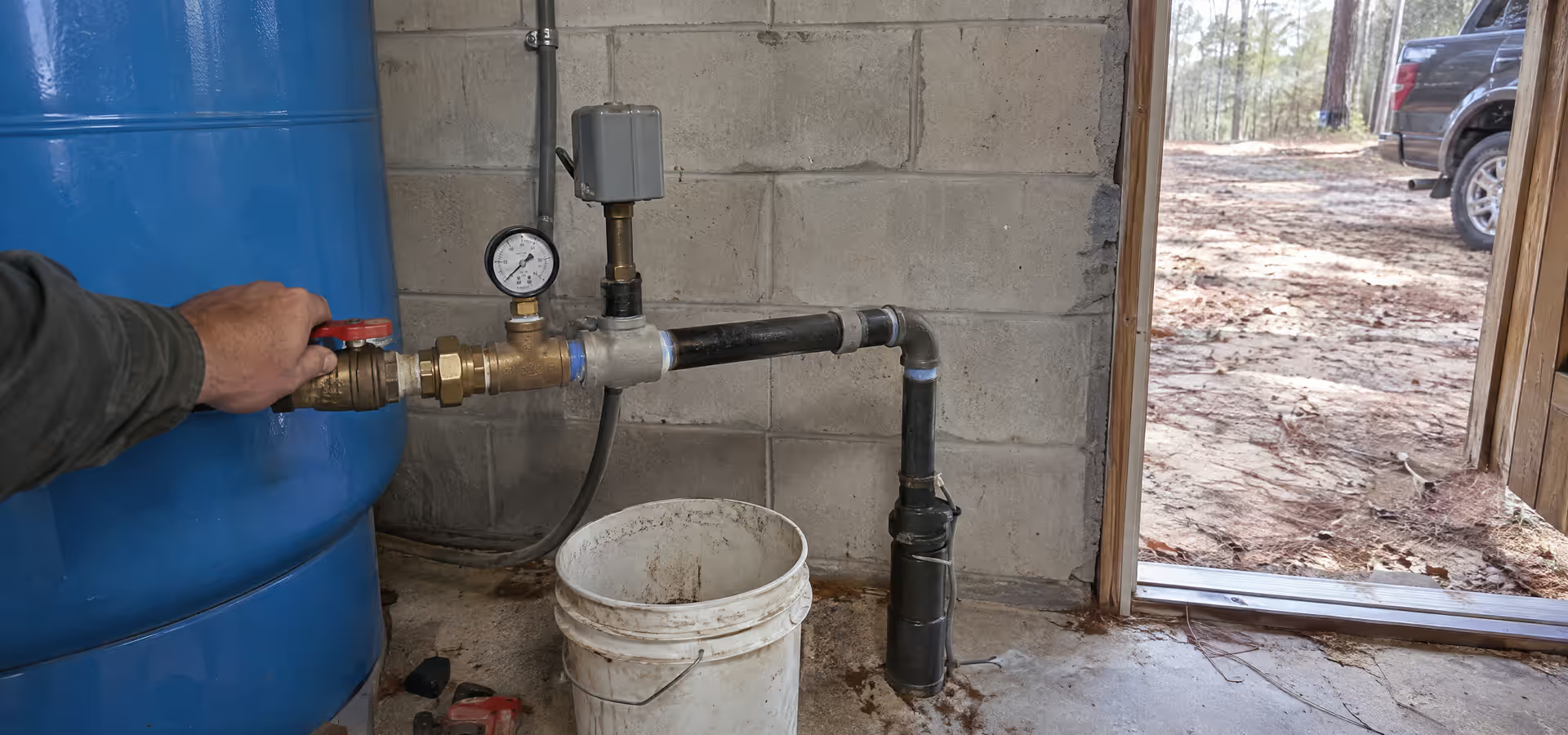
We close the valve at your tank and pressurize the buried run on its own. That separates a leak in the house from a leak out at the well, without digging anything on a guess.
-
Confirm the water level before replacing anything
We drop a tape down the casing and run 1 hour at design flow. That shows whether your pump is failing or simply set too high for August. Replacing a pump does not raise the water table.
What continuous running costs if it is left alone
The motor is what is on the clock
A submersible motor is cooled by water flowing past it. Running against a leak keeps water moving, so it survives. Running with the intake sucking air does not. That is why a pump left running dry over a weekend is often beyond saving by the time anyone calls us.
Casing faults look exactly like line leaks
Where 15A NCAC 02C grouting was cut short, the space outside your casing becomes a path for water to move. A leak at a rusted casing joint reads at the gauge exactly like a split supply line. Only a camera down the well separates them.
The well record narrows the search
Total depth, casing depth and pump setting on your well record turn a guess into a short list. Without it we would be picking where to dig on instinct. That is how a simple leak becomes an afternoon of trenching you pay for.
Numbers worth knowing
| First action | Switch the breaker off |
|---|---|
| Normal cut-out | 60 psi |
| Stalled pump signature | Climbs then holds |
| Leak signature | Falls when pump pauses |
| Motor cooling | Flow past the stator |
| Level test | 1 hour at design flow |
Well pump work in Fayetteville runs $150 to $3,500 for most homes. What decides the number is whether the fault sits outside the well or in it, and how deep the pump hangs.
| What the job is | Typical range | Unit |
|---|---|---|
| External component: pressure switch, control box, wiring, primingThe pump itself is fine. Cheapest outcome and the most common one. | $150 – $500 | installed |
| Pressure tank replacementTank, tank tee, gauge, switch and fittings, sized on drawdown. A waterlogged tank is what makes a pump short-cycle. | $1,000 – $2,300 | installed |
| Shallow well or jet pump, to about 25 ftCommon on Coastal Plain sand wells, where the water table sits high enough that a jet pump still works. | $600 – $1,400 | installed |
| Deep submersible pump, well 100 to 200 ftTypical Fayetteville well depth. Price covers pulling the old pump, drop pipe and wire. | $1,500 – $2,500 | installed |
| Deep submersible pump, well 300 to 400 ft or higher horsepowerDepth drives horsepower and hoist labor together. Every extra 100 ft adds roughly $500 to $1,000 in pipe, wire and time. | $2,800 – $5,500 | installed |
| Full system replacement: pump, tank, wiringWorth doing together when the pump is original and the tank is the same age. | $3,500 – $6,000 | installed |
What moves the number
- Every additional 100 ft of well depth+$500 to $1,000
- Emergency, weekend or after-hours call+25% to 50%
A pump that never stops is not working hard. It is losing a race, and the entry fee is the motor.Cumberland County, NC
Who we work for
- Well and Pump Service for Farms Stock water, wash-down, irrigation and a farmhouse on one well. Sized on sustained draw, not acreage.
- Well Service for Mobile Home Parks Shared supply with tenants attached. Past 15 connections it stops being a private well at all.
- Well Service for Churches and Camps Idle most of the week, then a full building. The hardest duty cycle in private water supply.
No water this morning?
Tell us what the pump is doing and we will tell you what it costs to put right.
Questions we get asked
Why is my well pump running constantly?
2 causes account for nearly all of it: the system is losing water faster than the pump can supply, or the pump can no longer reach the cut-out pressure. The gauge separates them in about a minute.
Should I turn the pump off if it will not stop?
Yes, immediately. A motor running against a fault it cannot resolve overheats once flow drops, and 1 weekend of continuous dry running is enough to turn a repairable system into a full replacement.
How do I know if it is a leak or the pump?
60 psi is where a healthy system stops. A pump that climbs to 45 psi and holds there has worn out. A gauge that falls back the moment the pump pauses is reporting a leak, usually in the buried run.
How much does this cost to fix?
$150 to $500 covers a check valve or a switch, which is the cheap end. A buried line repair sits in the middle, and a worn pump end or motor moves the job into the $1,500 to $2,500 replacement band.
Who fixes a well pump that runs constantly near me?
Fayetteville Well Pump Repair takes continuous-run calls as emergencies across Fayetteville and Cumberland County, because the motor is the part being consumed while the fault goes unfound.
Can a running pump mean the well is going dry?
1 in a handful of these calls is a level problem rather than a hardware problem, and late summer is when it shows. A tape in the casing reads static level directly instead of inferring it from behavior at the tap.
Continuous running is the one well fault where the delay costs more than the repair. Turning the breaker off protects the motor while the diagnosis happens, and the diagnosis is a gauge, a tape and an isolation valve rather than a truck full of parts. Where the fault turns out to be a worn pump end, submersible replacement covers the options, and short cycling covers the opposite symptom with the same underlying cause.